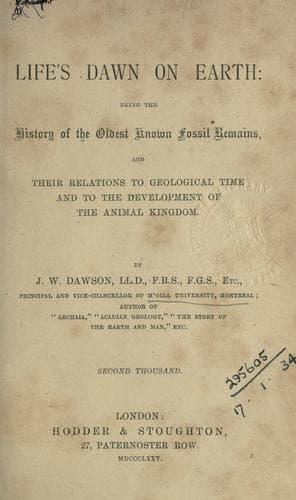
Life's Dawn on Earth: Being the history of the oldest known fossil remains, and their relations to geological time and to the development of the animal kingdomDawson, John William, Sir
History
Life's Dawn on Earth: Being the history of the oldest known fossil remains, and their relations to geological time and to the development of the animal kingdom
Dawson, John William, Sir
Life -- Origin; Paleontology -- Precambrian
Carpenter, and represented in specimens
in my collection presented by him, was evidently of the same type with
that preserved in the canals of these ancient fossils. Fig. 10 is an
accurate representation of the first seen group of canals penetrated by
serpentine.
[Illustration: Fig. 8. _Weathered Specimen of Eozoon from the Calumet._
(Collected by Mr. McMullen.)]
[Illustration: Fig. 9. _Cross Section of the Specimen represented in
Fig. 8._
The dark parts are the laminæ of calcareous matter converging to the
outer surface.]
On showing the structures discovered to Sir William Logan, he entered
into the matter with enthusiasm, and had a great number of slices and
afterwards of decalcified specimens prepared, which were placed in my
hands for examination.
Feeling that the discovery was most important, but that it would be
met with determined scepticism by a great many geologists, I was
not content with examining the typical specimens of Eozoon, but had
slices prepared of every variety of Laurentian limestone, of altered
limestones from the Primordial and Silurian, and of serpentine
marbles of all the varieties furnished by our collections. These were
examined with ordinary and polarized light, and with every variety
of illumination. Dr. Hunt, on his part, undertook the chemical
investigation of the various associated minerals. An extensive series
of notes and camera tracings were made of all the appearances observed;
and of some of the more important structures beautiful drawings
were executed by the late Mr. H. S. Smith, the then palæontological
draughtsman of the Survey. The result of the whole investigation was a
firm conviction that the structure was organic and foraminiferal, and
that it could be distinguished from any merely mineral or crystalline
forms occurring in these or other limestones.
[Illustration: Fig. 10. _Group of Canals in the Supplemental Skeleton
of Eozoon._
Taken from the specimen in which they were first recognised.
Magnified.]
Public-domain text, read in full here on John Shaqi.
Reviews
Reviews
No reviews yet
Be the first to share your thoughts on this work.
Join the Discussion
Join the discussion
Sign in to leave a comment or review.
Sign InorCreate an account