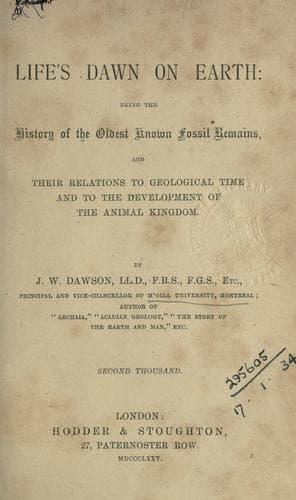
Life's Dawn on Earth: Being the history of the oldest known fossil remains, and their relations to geological time and to the development of the animal kingdomDawson, John William, Sir
History
Life's Dawn on Earth: Being the history of the oldest known fossil remains, and their relations to geological time and to the development of the animal kingdom
Dawson, John William, Sir
Life -- Origin; Paleontology -- Precambrian
those old seas proportionate to the great supplies of carbonic acid
in the atmosphere and in the waters, and if the Eozoic ocean was even
better supplied with carbonate of lime than those Silurian seas whose
vast limestones bear testimony to their richness in such material, we
can easily imagine that the conditions may have been more favourable
to a creature like Eozoon than those of any other period of geological
time.
Growing, as Eozoon did, on the floor of the ocean, and covering wide
patches with more or less irregular masses, it must have thrown up from
its whole surface its pseudopods to seize whatever floating particles
of food the waters carried over it. There is also reason to believe,
from the outline of certain specimens, that it often grew upward in
cylindrical or club-shaped forms, and that the broader patches were
penetrated by large pits or oscula, admitting the sea-water deeply into
the substance of the masses. In this way its growth might be rapid and
continuous; but it does not seem to have possessed the power of growing
indefinitely by new and living layers covering those that had died,
in the manner of some corals. Its life seems to have had a definite
termination, and when that was reached an entirely new colony had to
be commenced. In this it had more affinity with the Foraminifera, as
we now know them, than with the corals, though practically it had the
same power with the coral polyps of accumulating limestone in the sea
bottom, a power indeed still possessed by its foraminiferal successors.
In the case of coral limestones, we know that a large proportion of
these consist not of continuous reefs but of fragments of coral mixed
with other calcareous organisms, spread usually by waves and currents
in continuous beds over the sea bottom. In like manner we find in
the limestones containing Eozoon, layers of fragmental matter which
shows in places the characteristic structures, and which evidently
represents the debris swept from the Eozoic masses and reefs by the
action of the waves. It is with this fragmental matter that the small
rounded organisms already referred to most frequently occur; and while
they may be distinct animals, they may also be the fry of Eozoon, or
small portions of its acervuline upper surface floated off in a living
state, and possibly capable of living independently and of founding new
colonies.
Public-domain text, read in full here on John Shaqi.
Reviews
Reviews
No reviews yet
Be the first to share your thoughts on this work.
Join the Discussion
Join the discussion
Sign in to leave a comment or review.
Sign InorCreate an account