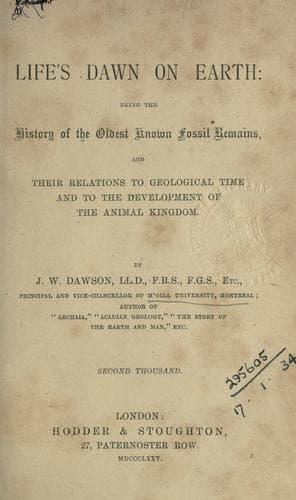
Life's Dawn on Earth: Being the history of the oldest known fossil remains, and their relations to geological time and to the development of the animal kingdomDawson, John William, Sir
History
Life's Dawn on Earth: Being the history of the oldest known fossil remains, and their relations to geological time and to the development of the animal kingdom
Dawson, John William, Sir
Life -- Origin; Paleontology -- Precambrian
"The successive layers, each having its own proper wall, are
often superposed one upon another without the intervention of any
supplemental or intermediate skeleton such as presents itself in
all the more massive forms of the Nummuline series; but a deposit
of this form of shell-substance, readily distinguishable by its
homogeneousness from the finely tubular shell immediately investing
the segments of the sarcode-body, is the source of the great
thickening which the calcareous zones often present in vertical
sections of Eozoon. The presence of this intermediate skeleton has
been correctly indicated by Dr. Dawson; but he does not seem to have
clearly differentiated it from the proper wall of the chambers.
All the tubuli which he has described belong to that canal system
which, as I have shown,[T] is limited in its distribution to the
intermediate skeleton, and is expressly designed to supply a channel
for its nutrition and augmentation. Of this canal system, which
presents most remarkable varieties in dimensions and distribution, we
learn more from the casts presented by decalcified specimens, than
from sections, which only exhibit such parts of it as their plane may
happen to traverse. Illustrations from both sources, giving a more
complete representation of it than Dr. Dawson's figures afford, have
been prepared from the additional specimens placed in my hands.
[Footnote T: _Op. cit._, pp. 50, 51.]
"It does not appear to me that the canal system takes its origin
directly from the cavity of the chambers. On the contrary, I believe
that, as in Calcarina (which Dr. Dawson has correctly referred to as
presenting the nearest parallel to it among recent Foraminifera),
they originate in lacunar spaces on the outside of the proper
walls of the chambers, into which the tubuli of those walls open
externally; and that the extensions of the sarcode-body which
occupied them were formed by the coalescence of the pseudopodia
issuing from those tubuli.[U]
[Footnote U: _Op. cit._, p. 221.]
Public-domain text, read in full here on John Shaqi.
Reviews
Reviews
No reviews yet
Be the first to share your thoughts on this work.
Elsewhere in the archive
Join the Discussion
Join the discussion
Sign in to leave a comment or review.
Sign InorCreate an account