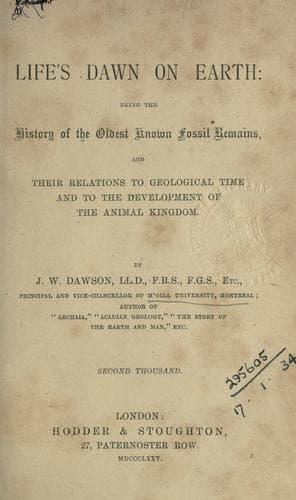
Life's Dawn on Earth: Being the history of the oldest known fossil remains, and their relations to geological time and to the development of the animal kingdomDawson, John William, Sir
History
Life's Dawn on Earth: Being the history of the oldest known fossil remains, and their relations to geological time and to the development of the animal kingdom
Dawson, John William, Sir
Life -- Origin; Paleontology -- Precambrian
"It seems to me worthy of special notice, that the canal system,
wherever displayed in transparent sections, is distinguished by a
yellowish brown coloration, so exactly resembling that which I have
observed in the canal system of recent Foraminifera (as Polystomella
and Calcarina) in which there were remains of the sarcode-body, that
I cannot but believe the infiltrating mineral to have been dyed by
the remains of sarcode still existing in the canals of Eozoon at the
time of its consolidation. If this be the case, the preservation
of this colour seems to indicate that no considerable metamorphic
action has been exerted upon the rock in which this fossil occurs.
And I should draw the same inference from the fact that the organic
structure of the shell is in many instances even more completely
preserved than it usually is in the Nummulites and other Foraminifera
of the Nummulitic limestone of the early Tertiaries.
"To sum up,--That the _Eozoon_ finds its proper place in the
Foraminiferal series, I conceive to be conclusively proved by its
accordance with the great types of that series, in all the essential
characters of organization;--namely, the structure of the shell
forming the proper wall of the chambers, in which it agrees precisely
with Nummulina and its allies; the presence of an intermediate
skeleton and an elaborate canal system, the disposition of which
reminds us most of Calcarina; a mode of communication of the chambers
when they are most completely separated, which has its exact parallel
in Cycloclypeus; and an ordinary want of completeness of separation
between the chambers, corresponding with that which is characteristic
of Carpenteria.
"There is no other group of the animal kingdom to which Eozoon
presents the slightest structural resemblance; and to the suggestion
that it may have been of kin to Nullipore, I can offer the most
distinct negative reply, having many years ago carefully studied the
structure of that stony Alga, with which that of Eozoon has nothing
whatever in common.
"The objections which not unnaturally occur to those familiar with
only the ordinary forms of Foraminifera, as to the admission of
Eozoon into the series, do not appear to me of any force. These have
reference in the first place to the great _size_ of the organism; and
in the second, to its exceptional mode of growth.
Public-domain text, read in full here on John Shaqi.
Reviews
Reviews
No reviews yet
Be the first to share your thoughts on this work.
Elsewhere in the archive
Join the Discussion
Join the discussion
Sign in to leave a comment or review.
Sign InorCreate an account