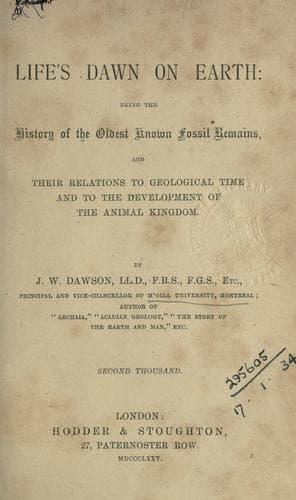
Life's Dawn on Earth: Being the history of the oldest known fossil remains, and their relations to geological time and to the development of the animal kingdomDawson, John William, Sir
History
Life's Dawn on Earth: Being the history of the oldest known fossil remains, and their relations to geological time and to the development of the animal kingdom
Dawson, John William, Sir
Life -- Origin; Paleontology -- Precambrian
"1. It must be borne in mind that all the Foraminifera normally
increase by the continuous gemmation of new segments from those
previously formed; and that we have, in the existing types, the
greatest diversities in the extent to which this gemmation may
proceed. Thus in the Globigerinæ, whose shells cover to an unknown
thickness the sea bottom of all that portion of the Atlantic Ocean
which is traversed by the Gulf Stream, only eight or ten segments
are ordinarily produced by continuous gemmation; and if new segments
are developed from the last of these, they detach themselves so
as to lay the foundation of independent Globigerinæ. On the other
hand in Cycloclypeus, which is a discoidal structure attaining two
and a quarter inches in diameter, the number of segments formed by
continuous gemmation must be many thousand. Again, the Receptaculites
of the Canadian Silurian rocks, shown by Mr. Salter's drawings[V]
to be a gigantic Orbitolite, attains a diameter of twelve inches;
and if this were to increase by vertical as well as by horizontal
gemmation (after the manner of Tinoporus or Orbitoides) so that one
discoidal layer would be piled on another, it would form a mass
equalling Eozoon in its ordinary dimensions. To say, therefore, that
Eozoon cannot belong to the Foraminifera on account of its gigantic
size, is much as if a botanist who had only studied plants and
shrubs were to refuse to admit a tree into the same category. The
very same continuous gemmation which has produced an Eozoon would
produce an equal mass of independent Globigerinæ, if after eight
or ten repetitions of the process, the new segments were to detach
themselves.
[Footnote V: _First Decade of Canadian Fossils_, pl. x.]
"It is to be remembered, moreover, that the largest masses of sponges
are formed by continuous gemmation from an original Rhizopod segment;
and that there is no _à priori_ reason why a Foraminiferal organism
should not attain the same dimensions as a Poriferal one,--the
intimate relationship of the two groups, notwithstanding the
difference between their skeletons, being unquestionable.
Public-domain text, read in full here on John Shaqi.
Reviews
Reviews
No reviews yet
Be the first to share your thoughts on this work.
Elsewhere in the archive
Join the Discussion
Join the discussion
Sign in to leave a comment or review.
Sign InorCreate an account