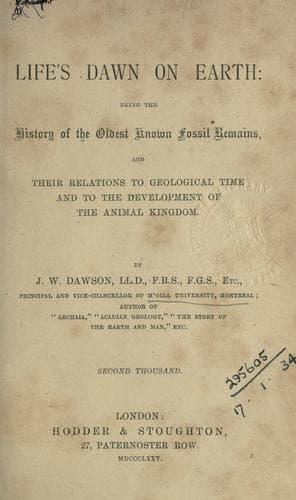
Life's Dawn on Earth: Being the history of the oldest known fossil remains, and their relations to geological time and to the development of the animal kingdomDawson, John William, Sir
History
Life's Dawn on Earth: Being the history of the oldest known fossil remains, and their relations to geological time and to the development of the animal kingdom
Dawson, John William, Sir
Life -- Origin; Paleontology -- Precambrian
"2. The difficulty arising from the zoophytic plan of growth of
Eozoon is at once disposed of by the fact that we have in the recent
Polytrema (as I have shown, _op. cit._, p. 235) an organism nearly
allied in all essential points of structure to Rotalia, yet no
less aberrant in its plan of growth, having been ranked by Lamarck
among the Millepores. And it appears to me that Eozoon takes its
place quite as naturally in the Nummuline series as Polytrema in
the Rotaline. As we are led from the typical Rotalia, through the
less regular Planorbulina, to Tinoporus, in which the chambers are
piled up vertically, as well as multiplied horizontally, and thence
pass by an easy gradation to Polytrema, in which all regularity of
external form is lost; so may we pass from the typical Operculina or
Nummulina, through Heterostegina and Cycloclypeus to Orbitoides, in
which, as in Tinoporus, the chambers multiply both by horizontal and
by vertical gemmation; and from Orbitoides to Eozoon the transition
is scarcely more abrupt than from Tinoporus to Polytrema.
"The general acceptance, by the most competent judges, of my views
respecting the primary value of the characters furnished by the
intimate structure of the shell, and the very subordinate value
of plan of growth, in the determination of the affinities of
Foraminifera, renders it unnecessary that I should dwell further on
my reasons for unhesitatingly affirming the Nummuline affinities of
Eozoon from the microscopic appearances presented by the proper wall
of its chambers, notwithstanding its very aberrant peculiarities;
and I cannot but feel it to be a feature of peculiar interest in
geological inquiry, that the true relations of by far the earliest
fossil yet known should be determinable by the comparison of a
portion which the smallest pin's head would cover, with organisms at
present existing."
(C.) Note on Specimens From Long Lake and Wentworth.
[_Journal of Geological Society_, August, 1867.]
Public-domain text, read in full here on John Shaqi.
Reviews
Reviews
No reviews yet
Be the first to share your thoughts on this work.
Elsewhere in the archive
Join the Discussion
Join the discussion
Sign in to leave a comment or review.
Sign InorCreate an account