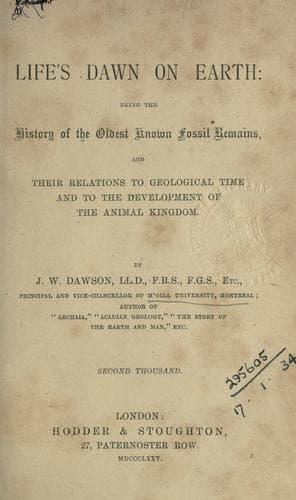
Life's Dawn on Earth: Being the history of the oldest known fossil remains, and their relations to geological time and to the development of the animal kingdomDawson, John William, Sir
History
Life's Dawn on Earth: Being the history of the oldest known fossil remains, and their relations to geological time and to the development of the animal kingdom
Dawson, John William, Sir
Life -- Origin; Paleontology -- Precambrian
When calcareous fossils of irregular surface and porous or cellular
texture, such as Eozoon was or corals were and are, become imbedded
in clay, marl, or other soft sediment, they can be washed out and
recovered in a condition similar to that of recent specimens, except
that their pores or cells if open may be filled with the material of
the matrix, or if not so open that they can be thus filled, they may be
more or less incrusted with mineral deposits introduced by water, or
may even be completely filled up in this way. But if such fossils are
contained in hard rocks, they usually fail, when these are broken, to
show their external surfaces, and, breaking across with the containing
rock, they exhibit their internal structure merely,--and this more
or less distinctly, according to the manner in which their cells or
cavities have been filled. Here the microscope becomes of essential
service, especially when the structures are minute. A fragment of
fossil wood which to the naked eye is nothing but a dark stone, or a
coral which is merely a piece of gray or coloured marble, or a specimen
of common crystalline limestone made up originally of coral fragments,
presents, when sliced and magnified, the most perfect and beautiful
structure. In such cases it will be found that ordinarily the original
substance of the fossil remains, in a more or less altered state. Wood
may be represented by dark lines of coaly matter, or coral by its
white or transparent calcareous laminæ; while the material which has
been introduced and which fills the cavities may so differ in colour,
transparency, or crystalline structure, as to act differently on
light, and so reveal the structure. These fillings are very curious.
Sometimes they are mere earthy or muddy matter. Sometimes they are
pure and transparent and crystalline. Often they are stained with
oxide of iron or coaly matter. They may consist of carbonate of lime,
silica or silicates, sulphate of baryta, oxides of iron, carbonate of
iron, iron pyrite, or sulphides of copper or lead, all of which are
common materials. They are sometimes so complicated that I have seen
even the minute cells of woody structures, each with several bands of
differently coloured materials deposited in succession, like the coats
of an onyx agate.
Public-domain text, read in full here on John Shaqi.
Reviews
Reviews
No reviews yet
Be the first to share your thoughts on this work.
Elsewhere in the archive
Join the Discussion
Join the discussion
Sign in to leave a comment or review.
Sign InorCreate an account