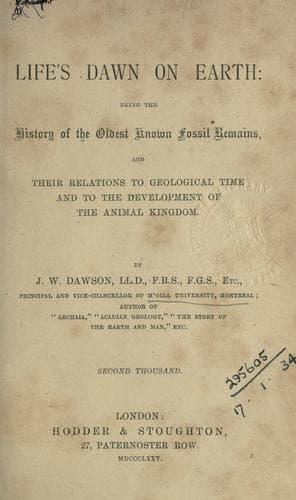
Life's Dawn on Earth: Being the history of the oldest known fossil remains, and their relations to geological time and to the development of the animal kingdomDawson, John William, Sir
History
Life's Dawn on Earth: Being the history of the oldest known fossil remains, and their relations to geological time and to the development of the animal kingdom
Dawson, John William, Sir
Life -- Origin; Paleontology -- Precambrian
I may mention here a peculiar and interesting structure which has
been detected in one of my specimens while these sheets were passing
through the press. It is an abnormal thickening of the calcareous
wall, extending across several layers, and perforated with large
parallel cylindrical canals, filled with dolomite, and running in
the direction of the laminæ; the intervening calcite being traversed
by a very fine and delicate canal system. It makes a nearer approach
to some of the Stromatoporæ mentioned in Chapter VI. than any other
Laurentian structure hitherto observed, and may be either an abnormal
growth of Eozoon, consequent on some injury, or a parasitic mass of
some Stromatoporoid organism overgrown by the laminæ of the fossil.
The structure of the dolomite in this specimen indicates that it
first lined the canals, and afterward filled them; an appearance
which I have also observed recently in the larger canals filled
with serpentine (Plate VIII., fig. 5). The cut below is an attempt,
only partially successful, to show the Amœba-like appearance, when
magnified, of the casts of the chambers of Eozoon, as seen on the
decalcified surface of a specimen broken parallel to the laminæ.
[Illustration: Fig. 21_a_.]
[Illustration:
Plate V.
_Nature-print of Eozoon, showing laminated, acervuline, and fragmental
portions._
This is printed from an electrotype taken from an etched slab of
Eozoon, and not touched with a graver except to remedy some accidental
flaws in the plate. The diagonal white line marks the course of a
calcite vein.]
CHAPTER V.
THE PRESERVATION OF EOZOON.
Perhaps nothing excites more scepticism as to this ancient fossil
than the prejudice existing among geologists that no organism can be
preserved in rocks so highly metamorphic as those of the Laurentian
series. I call this a prejudice, because any one who makes the
microscopic structure of rocks and fossils a special study, soon learns
that fossils undergo the most remarkable and complete chemical changes
without losing their minute structure, and that calcareous rocks if
once fossiliferous are hardly ever so much altered as to lose all
trace of the organisms which they contained, while it is a most common
occurrence to find highly crystalline rocks of this kind abounding in
fossils preserved as to their minute structure.
Let us, however, look at the precise conditions under which this takes
place.
Public-domain text, read in full here on John Shaqi.
Reviews
Reviews
No reviews yet
Be the first to share your thoughts on this work.
Elsewhere in the archive
Join the Discussion
Join the discussion
Sign in to leave a comment or review.
Sign InorCreate an account