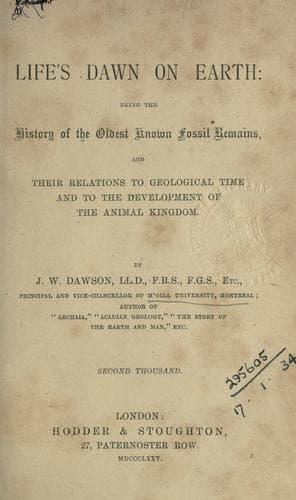
Life's Dawn on Earth: Being the history of the oldest known fossil remains, and their relations to geological time and to the development of the animal kingdomDawson, John William, Sir
History
Life's Dawn on Earth: Being the history of the oldest known fossil remains, and their relations to geological time and to the development of the animal kingdom
Dawson, John William, Sir
Life -- Origin; Paleontology -- Precambrian
With regard to the calcareous organisms with which we have now to do,
when these are imbedded in pure limestone and filled with the same, so
that the whole rock, fossils and all, is identical in composition, and
when metamorphic action has caused the whole to become crystalline,
and perhaps removed the remains of carbonaceous matter, it may be very
difficult to detect any traces of fossils. But even in this case
careful management of light may reveal indications of structure, as in
some specimens of Eozoon described by the writer and Dr. Carpenter. In
many cases, however, even where the limestones have become perfectly
crystalline, and the cleavage planes cut freely across the fossils,
these exhibit their forms and minute structure in great perfection.
This is the case in many of the Lower Silurian limestones of Canada,
as I have elsewhere shown.[X] The gray crystalline Trenton limestone
of Montreal, used as a building stone, is an excellent illustration
of this. To the naked eye it is a gray marble composed of cleavable
crystals; but when examined in thin slices, it shows its organic
fragments in the greatest perfection, and all the minute structures
are perfectly marked out by delicate carbonaceous lines. The only
exception in this limestone is in the case of the Crinoids, in which
the cellular structure is filled with transparent calc-spar, perfectly
identical with the original solid matter, so that they appear solid
and homogeneous, and can be recognised only by their external forms.
The specimen represented in fig. 23, is a mass of Corals, Bryozoa, and
Crinoids, and shows these under a low power, as represented in the
figure; but to the naked eye it is merely a gray crystalline limestone.
The specimen represented in fig. 24 shows the Laurentian Eozoon in a
similar state of preservation. It is from a sketch by Dr. Carpenter,
and shows the delicate canals partly filled with calcite as clear and
colourless as that of the shell itself, and distinguishable only by
careful management of the light.
[Footnote X: _Canadian Naturalist_, 1859; Microscopic Structure of
Canadian Limestones.]
[Illustration: Fig. 23. _Slice of Crystalline Lower Silurian Limestone;
showing Crinoids, Bryozoa, and Corals in fragments._]
[Illustration: Fig. 24. _Wall of Eozoon penetrated with Canals. The
unshaded portions filled with Calcite._ (_After Carpenter._)]
Public-domain text, read in full here on John Shaqi.
Reviews
Reviews
No reviews yet
Be the first to share your thoughts on this work.
Elsewhere in the archive
Join the Discussion
Join the discussion
Sign in to leave a comment or review.
Sign InorCreate an account