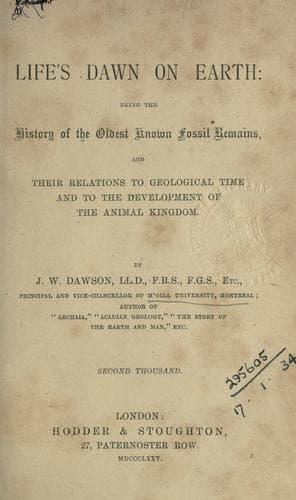
Life's Dawn on Earth: Being the history of the oldest known fossil remains, and their relations to geological time and to the development of the animal kingdomDawson, John William, Sir
History
Life's Dawn on Earth: Being the history of the oldest known fossil remains, and their relations to geological time and to the development of the animal kingdom
Dawson, John William, Sir
Life -- Origin; Paleontology -- Precambrian
In the case of recent and fossil Foraminifers, these--when not so
little mineralized that their chambers are empty, or only partially
filled, which is sometimes the case even with Eocene Nummulites
and Cretaceous forms of smaller size,--are very frequently filled
solid with calcareous matter, and as Dr. Carpenter well remarks,
even well preserved Tertiary Nummulites in this state often fail
greatly in showing their structures, though in the same condition
they occasionally show these in great perfection. Among the finest
I have seen are specimens from the Mount of Olives (fig. 19), and
Dr. Carpenter mentions as equally good those of the London clay of
Bracklesham. But in no condition do modern Foraminifera or those of
the Tertiary and Mesozoic rocks appear in greater perfection than when
filled with the hydrous silicate of iron and potash called glauconite,
and which gives by the abundance of its little bottle-green concretions
the name of "green-sand" to formations of this age both in Europe and
America. In some beds of green-sand every grain seems to have been
moulded into the interior of a microscopic shell, and has retained
its form after the frail envelope has been removed. In some cases the
glauconite has not only filled the chambers but has penetrated the
fine tubulation, and when the shell is removed, either naturally or
by the action of an acid, these project in minute needles or bundles
of threads from the surface of the cast. It is in the warmer seas,
and especially in the bed of the Ægean and of the Gulf Stream, that
such specimens are now most usually found. If we ask why this mineral
glauconite should be associated with Foraminiferal shells, the answer
is that they are both products of one kind of locality. The same sea
bottoms in which Foraminifera most abound are also those in which for
some unknown chemical reason glauconite is deposited. Hence no doubt
the association of this mineral with the great Foraminiferal formation
of the chalk. It is indeed by no means unlikely that the selection
by these creatures of the pure carbonate of lime from the sea-water
or its minute plants, may be the means of setting free the silica,
iron, and potash, in a state suitable for their combination. Similar
silicates are found associated with marine limestones, as far back as
the Silurian age; and Dr. Sterry Hunt, than whom no one can be a better
authority on chemical geology, has argued on chemical grounds that the
occurrence of serpentine with the remains of Eozoon is an association
of the same character.
Public-domain text, read in full here on John Shaqi.
Reviews
Reviews
No reviews yet
Be the first to share your thoughts on this work.
Elsewhere in the archive
Join the Discussion
Join the discussion
Sign in to leave a comment or review.
Sign InorCreate an account