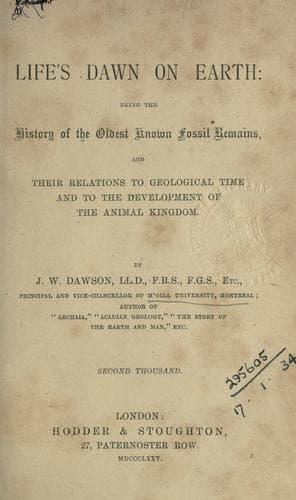
Life's Dawn on Earth: Being the history of the oldest known fossil remains, and their relations to geological time and to the development of the animal kingdomDawson, John William, Sir
History
Life's Dawn on Earth: Being the history of the oldest known fossil remains, and their relations to geological time and to the development of the animal kingdom
Dawson, John William, Sir
Life -- Origin; Paleontology -- Precambrian
It is only necessary to refer to the attempts which have been made to
explain by merely mineral deposits the occurrence of the serpentine
in the canals and chambers of Eozoon, and its presenting the form it
does, to see that this is the case. Prof. Rowney, for example, to avoid
the force of the argument from the canal system, is constrained to
imagine that the whole mass has at one time been serpentine, and that
this has been partially washed away, and replaced by calcite. If so,
whence the deposition of the supposed mass of serpentine, which has to
be accounted for in this way as well as in the other? How did it happen
to be eroded into so regular chambers, leaving intermediate floors and
partitions. And, more wonderful still, how did the regular dendritic
bundles, so delicate that they are removed by a breath, remain perfect,
and endure until they were imbedded in calcareous spar? Further, how
does it happen that in some specimens serpentine and pyroxene seem to
have encroached upon the structure, as if they and not calcite were the
eroding minerals? How any one who has looked at the structures can for
a moment imagine such a possibility, it is difficult to understand. If
we could suppose the serpentine to have been originally deposited as
a cellular or laminated mass, and its cavities filled with calcite in
a gelatinous or semi-fluid state, we might suppose the fine processes
of serpentine to have grown outward into these cavities in the mass,
as fibres of oxide of iron or manganese have grown in the silica of
moss-agate; but this theory would be encompassed with nearly as great
mechanical and chemical difficulties. The only rational view that any
one can take of the process is, that the calcareous matter was the
original substance, and that it had delicate tubes traversing it which
became injected with serpentine. The same explanation, and no other,
will suffice for those delicate cell-walls, penetrated by innumerable
threads of serpentine, which must have been injected into pores. It is
true that there are in some of the specimens cracks filled with fibrous
serpentine or chrysotile, but these traverse the mass in irregular
directions, and they consist of closely packed angular prisms,
instead of a matrix of limestone penetrated by cylindrical threads of
serpentine. (Fig. 27.) Here I must once for all protest against the
tendency of some opponents of Eozoon to confound these structures and
the canal system of Eozoon with the acicular crystals, and dendritic
or coralloidal forms, observed in some minerals. It is easy to make
such comparisons appear plausible to the uninitiated, but practised
observers cannot be so deceived, the differences are too marked and
essential. In illustration of this, I may refer to the highly magnified
canals in figs. 28 and 29. Further, it is evident from the examination
of the specimens, that the chrysotile veins, penetrating as they often
do diagonally or transversely across both chambers and walls, must have
Public-domain text, read in full here on John Shaqi.
Reviews
Reviews
No reviews yet
Be the first to share your thoughts on this work.
Elsewhere in the archive
Join the Discussion
Join the discussion
Sign in to leave a comment or review.
Sign InorCreate an account