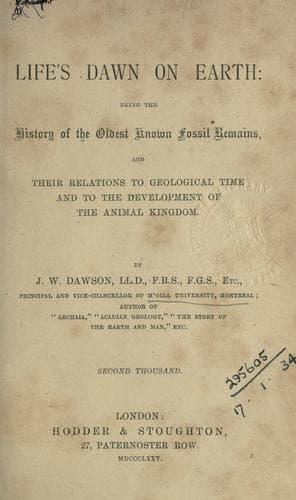
Life's Dawn on Earth: Being the history of the oldest known fossil remains, and their relations to geological time and to the development of the animal kingdomDawson, John William, Sir
History
Life's Dawn on Earth: Being the history of the oldest known fossil remains, and their relations to geological time and to the development of the animal kingdom
Dawson, John William, Sir
Life -- Origin; Paleontology -- Precambrian
had afterward been cracked by shrinkage, and the cracks filled with a
second deposit of serpentine. Now, serpentine is a hydrous silicate of
magnesia, and all that we need to suppose is that in the deposits of
the Laurentian sea magnesia was present instead of iron and potash,
and we can understand that the Laurentian fossil has been petrified
by infiltration with serpentine, as more modern Foraminifera have
been with glauconite, which, though it usually has little magnesia,
often has a considerable percentage of alumina. Further, in specimens
of Eozoon from Burgess, the filling mineral is loganite, a compound
of silica, alumina, magnesia and iron, with water, and in certain
Silurian limestones from New Brunswick and Wales, in which the delicate
microscopic pores of the skeletons of stalked star-fishes or Crinoids
have been filled with mineral deposits, so that when decalcified
these are most beautifully represented by their casts, Dr. Hunt has
proved the filling mineral to be a silicate of alumina, iron, magnesia
and potash, intermediate between serpentine and glauconite. We have,
therefore, ample warrant for adhering to Dr. Hunt's conclusion that
the Laurentian serpentine was deposited under conditions similar to
those of the modern green-sand. Indeed, independently of Eozoon, it is
impossible that any geologist who has studied the manner in which this
mineral is associated with the Laurentian limestones could believe it
to have been formed in any other way. Nor need we be astonished at
the fineness of the infiltration by which these minute tubes, perhaps
1/10000 of an inch in diameter, are filled with mineral matter. The
micro-geologist well knows how, in more modern deposits, the finest
pores of fossils are filled, and that mineral matter in solution
can penetrate the smallest openings that the microscope can detect.
Wherever the fluids of the living body can penetrate, there also
mineral substances can be carried, and this natural injection, effected
under great pressure and with the advantage of ample time, can surpass
any of the feats of the anatomical manipulator. Fig. 25 represents
a microscopic joint of a Crinoid from the Upper Silurian of New
Brunswick, injected with the hydrous silicate already referred to, and
fig. 26 shows a microscopic chambered or spiral shell, from a Welsh
Silurian limestone, with its cavities filled with a similar substance.
[Illustration: Fig. 25. _Joint of a Crinoid, having its pores injected
with a Hydrous Silicate._
Upper Silurian Limestone, Pole Hill, New Brunswick. Magnified 25
diameters.]
[Illustration: Fig. 26. _Shell from a Silurian Limestone, Wales; its
cavity filled with a Hydrous Silicate._
Magnified 25 diameters.]
Public-domain text, read in full here on John Shaqi.
Reviews
Reviews
No reviews yet
Be the first to share your thoughts on this work.
Elsewhere in the archive
Join the Discussion
Join the discussion
Sign in to leave a comment or review.
Sign InorCreate an account