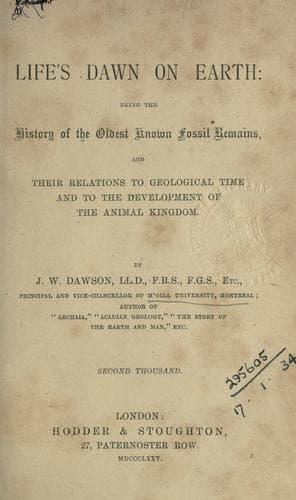
Life's Dawn on Earth: Being the history of the oldest known fossil remains, and their relations to geological time and to the development of the animal kingdomDawson, John William, Sir
History
Life's Dawn on Earth: Being the history of the oldest known fossil remains, and their relations to geological time and to the development of the animal kingdom
Dawson, John William, Sir
Life -- Origin; Paleontology -- Precambrian
In many parts of the skeleton of Eozoon, and even in the best
infiltrated serpentine specimens, there are portions of the cell-wall
and canal system which have been filled with calcareous spar or with
dolomite, so similar to the skeleton that it can be detected only under
the most favourable lights and with great care. (Fig. 24, _supra_.)
The same phenomena may be observed in joints of Crinoids from the
Palæozoic rocks, and they constitute proofs of organic origin even
more irrefragable than the filling with serpentine. Dr. Carpenter has
recently, in replying to the objections of Mr. Carter, made excellent
use of this feature of the preservation of Eozoon. It is further to
be remarked that in all the specimens of true Eozoon, as well as
in many other calcareous fossils preserved in ancient rocks, the
calcareous matter, even when its minute structures are not preserved
or are obscured, presents a minutely granular or curdled appearance,
arising no doubt from the original presence of organic matter, and not
recognised in purely inorganic calcite.
Another style of these remarkable fossils is that of the Burgess
specimens. In these the walls have been changed into dolomite
or magnesian limestone, and the canals seem to have been wholly
obliterated, so that only the laminated structure remains. The material
filling the chambers is also an aluminous silicate named loganite; and
this seems to have been introduced, not so much in solution, as in
the state of muddy slime, since it contains foreign bodies, as grains
of sand and little groups of silicious concretions, some of which are
not unlikely casts of the interior of minute foraminiferal shells
contemporary with Eozoon, and will be noticed in the sequel.
[Illustration: Fig. 30. _Eozoon from Tudor._
Two-thirds natural size. (_a._) Tubuli. (_b._) Canals. Magnified. _a_
and _b_ from another specimen.]
Public-domain text, read in full here on John Shaqi.
Reviews
Reviews
No reviews yet
Be the first to share your thoughts on this work.
Elsewhere in the archive
Join the Discussion
Join the discussion
Sign in to leave a comment or review.
Sign InorCreate an account