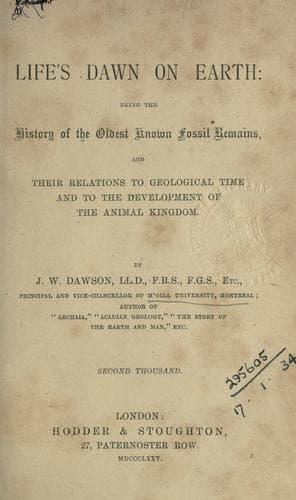
Life's Dawn on Earth: Being the history of the oldest known fossil remains, and their relations to geological time and to the development of the animal kingdomDawson, John William, Sir
History
Life's Dawn on Earth: Being the history of the oldest known fossil remains, and their relations to geological time and to the development of the animal kingdom
Dawson, John William, Sir
Life -- Origin; Paleontology -- Precambrian
Still another mode of occurrence is presented by a remarkable specimen
from Tudor in Ontario, and from beds probably on the horizon of the
Upper Laurentian or Huronian.[Y] It occurs in a rock scarcely at all
metamorphic, and the fossil is represented by white carbonate of lime,
while the containing matrix is a dark-coloured coarse limestone. In
this specimen the material filling the chambers has not penetrated
the canals except in a few places, where they appear filled with dark
carbonaceous matter. In mode of preservation these Tudor specimens
much resemble the ordinary fossils of the Silurian rocks. One of
the specimens in the collection of the Geological Survey (fig. 30)
presents a clavate form, as if it had been a detached individual
supported on one end at the bottom of the sea. It shows, as does
also the original Calumet specimen, the septa approaching each other
and coalescing at the margin of the form, where there were probably
orifices communicating with the exterior. Other specimens of fragmental
Eozoon from the Petite Nation localities have their canals filled with
dolomite, which probably penetrated them after they were broken up
and imbedded in the rock. I have ascertained with respect to these
fragments of Eozoon, that they occur abundantly in certain layers of
the Laurentian limestone, beds of some thickness being in great part
made up of them, and coarse and fine fragments occur in alternate
layers, like the broken corals in some Silurian limestones.
[Footnote Y: See Note B, Chap. III.]
Finally, on this part of the subject, careful observation of many
specimens of Laurentian limestone which present no trace of Eozoon
when viewed by the naked eye, and no evidence of structure when acted
on with acids, are nevertheless organic, and consist of fragments
of Eozoon, and possibly of other organisms, not infiltrated with
silicates, but only with carbonate of lime, and consequently revealing
only obscure indications of their minute structure. I have satisfied
myself of this by long and patient investigations, which scarcely admit
of any adequate representation, either by words or figures.
Public-domain text, read in full here on John Shaqi.
Reviews
Reviews
No reviews yet
Be the first to share your thoughts on this work.
Elsewhere in the archive
Join the Discussion
Join the discussion
Sign in to leave a comment or review.
Sign InorCreate an account