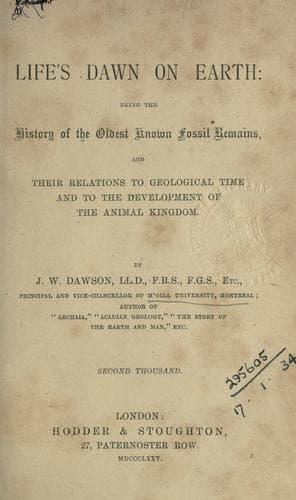
Life's Dawn on Earth: Being the history of the oldest known fossil remains, and their relations to geological time and to the development of the animal kingdomDawson, John William, Sir
History
Life's Dawn on Earth: Being the history of the oldest known fossil remains, and their relations to geological time and to the development of the animal kingdom
Dawson, John William, Sir
Life -- Origin; Paleontology -- Precambrian
If we now turn to other countries in search of contemporaries of
Eozoon, I may refer first to some specimens found by my friend Dr.
Honeyman at Arisaig, in Nova Scotia, in beds underlying the Silurian
rocks of that locality, but otherwise of uncertain age. I do not vouch
for them as Laurentian, and if of that age they seem to indicate a
species distinct from that of Canada proper. They differ in coarser
tubulation, and in their canals being large and beaded, and less
divergent. I proposed for these specimens, in some notes contributed to
the survey of Canada, the name _Eozoon Acadianum_.
Dr. Gümbel, the Director of the Geological Survey of Bavaria, is
one of the most active and widely informed of European geologists,
combining European knowledge with an extensive acquaintance with the
larger and in some respects more typical areas of the older rocks in
America, and stratigraphical geology with enthusiastic interest in the
microscopic structures of fossils. He at once and in a most able manner
took up the question of the application of the discoveries in Canada
to the rocks of Bavaria. The spirit in which he did so may be inferred
from the following extract:--
"The discovery of organic remains in the crystalline limestones of the
ancient gneiss of Canada, for which we are indebted to the researches
of Sir William Logan and his colleagues, and to the careful microscopic
investigations of Drs. Dawson and Carpenter, must be regarded as
opening a new era in geological science.
"This discovery overturns at once the notions hitherto commonly
entertained with regard to the origin of the stratified primary
limestones, and their accompanying gneissic and quartzose strata,
included under the general name of primitive crystalline schists. It
shows us that these crystalline stratified rocks, of the so-called
primary system, are only a backward prolongation of the chain of
fossiliferous strata; the elements of which were deposited as oceanic
sediment, like the clay-slates, limestones, and sandstones of the
palæozoic formations, and under similar conditions, though at a time
far more remote, and more favourable to the generation of crystalline
mineral compounds.
"In this discovery of organic remains in the primary rocks, we hail
with joy the dawn of a new epoch in the critical history of these
earlier formations. Already in its light, the primeval geological time
is seen to be everywhere animated, and peopled with new animal forms
of whose very existence we had previously no suspicion. Life, which
had hitherto been supposed to have first appeared in the Primordial
division of the Silurian period, is now seen to be immeasurably
lengthened beyond its former limit, and to embrace in its domain the
most ancient known portions of the earth's crust. It would almost
seem as if organic life had been awakened simultaneously with the
solidification of the earth's crust.
Public-domain text, read in full here on John Shaqi.
Reviews
Reviews
No reviews yet
Be the first to share your thoughts on this work.
Elsewhere in the archive
Join the Discussion
Join the discussion
Sign in to leave a comment or review.
Sign InorCreate an account