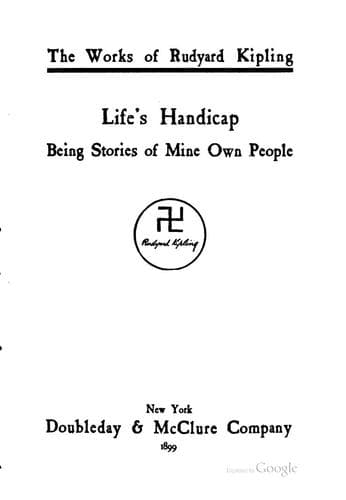
Life's Handicap: Being Stories of Mine Own PeopleKipling, Rudyard
History
Life's Handicap: Being Stories of Mine Own People
Kipling, Rudyard
India -- History -- British occupation, 1765-1947 -- Fiction; India -- Social life and customs -- Fiction; Short stories, English
I explained that he had been tramping in the dining-room and the
smoking-room and two or three other places, and he laughed and told me
to go back to bed. I went back to bed and slept till the morning, but
through all my mixed dreams I was sure I was doing some one an injustice
in not attending to his wants. What those wants were I could not tell;
but a fluttering, whispering, bolt-fumbling, lurking, loitering Someone
was reproaching me for my slackness, and, half awake, I heard the
howling of Tietjens in the garden and the threshing of the rain.
I lived in that house for two days. Strickland went to his office
daily, leaving me alone for eight or ten hours with Tietjens for my only
companion. As long as the full light lasted I was comfortable, and so
was Tietjens; but in the twilight she and I moved into the back verandah
and cuddled each other for company. We were alone in the house, but none
the less it was much too fully occupied by a tenant with whom I did not
wish to interfere. I never saw him, but I could see the curtains between
the rooms quivering where he had just passed through; I could hear
the chairs creaking as the bamboos sprung under a weight that had
just quitted them; and I could feel when I went to get a book from
the dining-room that somebody was waiting in the shadows of the front
verandah till I should have gone away. Tietjens made the twilight more
interesting by glaring into the darkened rooms with every hair erect,
and following the motions of something that I could not see. She never
entered the rooms, but her eyes moved interestedly: that was quite
sufficient. Only when my servant came to trim the lamps and make all
light and habitable she would come in with me and spend her time sitting
on her haunches, watching an invisible extra man as he moved about
behind my shoulder. Dogs are cheerful companions.
I explained to Strickland, gently as might be, that I would go over to
the Club and find for myself quarters there. I admired his hospitality,
was pleased with his guns and rods, but I did not much care for his
house and its atmosphere. He heard me out to the end, and then smiled
very wearily, but without contempt, for he is a man who understands
things. ‘Stay on,’ he said, ‘and see what this thing means. All you have
talked about I have known since I took the bungalow. Stay on and wait.
Tietjens has left me. Are you going too?’
I had seen him through one little affair, connected with a heathen
idol, that had brought me to the doors of a lunatic asylum, and I had
no desire to help him through further experiences. He was a man to whom
unpleasantnesses arrived as do dinners to ordinary people.
Therefore I explained more clearly than ever that I liked him immensely,
and would be happy to see him in the daytime; but that I did not care to
sleep under his roof. This was after dinner, when Tietjens had gone out
to lie in the verandah.
Public-domain text, read in full here on John Shaqi.
Reviews
Reviews
No reviews yet
Be the first to share your thoughts on this work.
Elsewhere in the archive
Join the Discussion
Join the discussion
Sign in to leave a comment or review.
Sign InorCreate an account