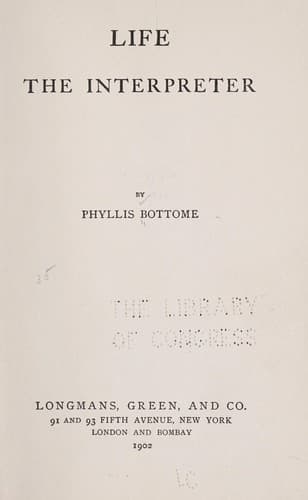
East End (London, England) -- Fiction; London (England) -- Social conditions -- Fiction; Social settlements -- Fiction
“YOU have not come to see me for some time, Jack, yet we used to
be good friends once, didn’t we? One seems to have one’s seasons
for those kind of things, then they drop out. With sleeves, you
know, one mustn’t keep the fashion on a bit too long. I have
known dressmakers—but I won’t trouble you with my philosophy. I
am going to have dear Mrs. Huntly and a charming cousin of hers
to dinner, and so thought you might, perhaps, care to join us,
though I’m candid enough to admit I hope it will not be merely
for the charming cousin’s sake.
“EDITH LE MENTIER.”
Jack Hurstly read the note, written on rich, heavy cream, a tiny,
definite hand between large margins. It all seemed very familiar to him.
Three years ago there used to be a drawer full of them, though he had
burned them of course, he remembered, after the scene in the garden. It
had all been very graceful and harmless, and he had immensely admired
and pitied her with her dense husband, who shattered her dainty little
subtleties with a heavy word or two, and “called things,” as she
plaintively remarked to Jack, “by their proper names, as if things,” she
had added, “should ever be called by names at all, and least of all by
their right ones.”
Then he had met Muriel. He thought of that first evening, and of her
frank, disarming look, and of how she not only did not say things she
did not mean, but actually went so far as to say the things she did.
It was a change from a little winding stream now here, now there, to a
free, open lake with its clear reflection from the sky.
It was natural that after this should come the scene in the garden; what
he could not understand was this little dinner three years afterwards.
Curiosity and Muriel’s wilful remoteness prompted him to accept the
invitation; but he did so formally.
Edith, when she read his letter, broke into a little laugh.
“A joke, my dear?” her husband asked, looking over his newspaper across
the breakfast table.
“Certainly not, Ted,” said Edith; “I should never dream of laughing at a
joke at breakfast time!” Her husband returned to his sporting
notes—they seemed to him so much easier to understand.
Mrs. le Mentier prepared to meet her guests by dressing in Jack
Hurstly’s favorite color. It happened to be the one which suited her;
but it is possible she would have worn it if it had not. It takes a
woman longer than three years to forget a man’s favorite colors, and
longer still not to wear them when she remembers.
Gladys Travers was the first to arrive, with Mary Huntly’s brother, a
deeply earnest young clergyman with thoughtful eyes. “Cyril had to bring
me,” she said, smiling, “because Mary had a headache, one of those
horrid dark-room ones, you know, with tea and toast. I don’t believe he
quite approves though of dinner parties, do you, Cyril?” Mrs. le Mentier
shook hands with him sympathetically.
Public-domain text, read in full here on John Shaqi.
Reviews
Reviews
No reviews yet
Be the first to share your thoughts on this work.
Join the Discussion
Join the discussion
Sign in to leave a comment or review.
Sign InorCreate an account