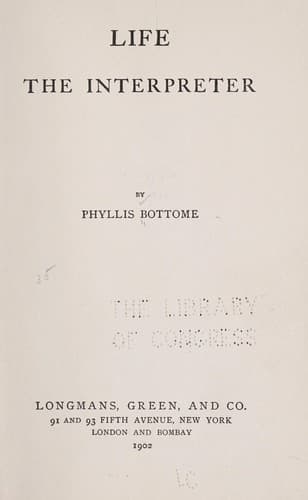
East End (London, England) -- Fiction; London (England) -- Social conditions -- Fiction; Social settlements -- Fiction
“You know what I think about the whole thing?” he said gravely.
“Ah, it’s _that_ which makes me tired!” she sighed. “All my friends say
just the same. They won’t think how—how hard they make it for
me—no—not even you.”
“Even me?” he asked quietly. She bit her lips; she was losing her head
it seemed; she must not do that.
“I take the ’bus at this corner,” she said.
“I think we’ll go by hansom,” said her escort. She smiled.
“You always _will_ contradict me, Captain Hurstly.”
“You will not contradict _me_ if I remind you that you used to call
me—Jack?” he ventured.
The hansom drove up, and Muriel put out her hand to him. She
unmistakably intended to go alone, even though she had let him choose
her vehicle.
“I may come and see you?” he asked. She frowned a little.
“I’m very busy, you know,” she said.
“Does that mean I’m not to come?”
“You might come,” she suggested suddenly, “and bring Mary’s little
cousin; she can’t come alone.”
“I can though,” he persisted. She shook her head and laughed merrily.
“Mary’s little cousin,” she said as she drove off, “or not at all!” And
he never went.
CHAPTER IV
“What’s the use of crying when the mother that bore ye (Mary,
pity women!) knew it all afore ye?”
THE club room, large and bare, with a bench or two and one long table,
was full of girls, though at first glance you might not have been
inclined to call them so. They were all so inexpressibly old. As they
stood talking in groups, large and broad, with their frowsy hair and
draggle-tailed dresses, lifting loud, rough voices and breaking from
time to time into hoarse roars of laughter, they could scarcely be
called prepossessing. These were the girls who had warned a
simple-minded lady Bible-reader that “if she didn’t tyke ’erself orf
they’d strip her”—and they would have done it.
As Muriel Dallerton entered the room the whole gang swarmed towards her
in greeting. They loved her. “She ’adn’t got no nonsense about ’er,”
“She was a real good sort, and no mistake,” and they showed their
appreciation of her by rushing from their ten hours’ work into the club
and paying with treasured pennies the tiny entrance fees she exacted for
the classes.
To-day was cooking class, and from a great cupboard were drawn two dozen
aprons, which they themselves had helped to buy and make.
Muriel knew just what wages they had, and never denied them the dignity
of giving a little, if they had that little to give.
Two long hours’ class followed. To the girls who were accustomed to
factory work it was mere play, and the pleasure and excitement of seeing
how Mary Ann’s scones or Minnie Newlove’s pie turned out was
inexhaustible.
It was not until it was over and the cooking boards and utensils put
away that Muriel missed one of the number. Lizzie Belk was a girl who
attended most regularly, and Muriel walked over to her mate to inquire
after her.
Public-domain text, read in full here on John Shaqi.
Reviews
Reviews
No reviews yet
Be the first to share your thoughts on this work.
Join the Discussion
Join the discussion
Sign in to leave a comment or review.
Sign InorCreate an account