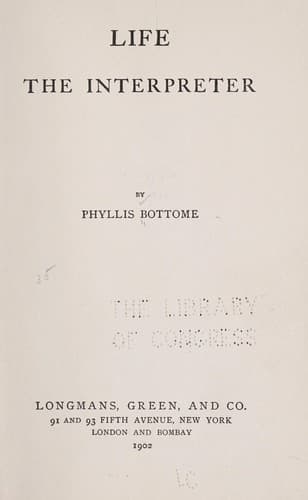
East End (London, England) -- Fiction; London (England) -- Social conditions -- Fiction; Social settlements -- Fiction
“Ah! there you’re mistaken,” said the doctor. “All your strength (and
Heaven knows you’ve got enough!) lies in weakness! When we come to the
bottom of it, emotion rules the world, and woman is queen of the
emotions.”
“Oh, doctor! doctor!” cried Muriel with uplifted hands. “Principles!
principles!” Geoff smiled grimly.
“Ah! principles,” he said; “they are very good things for theories, and
they act as a drug on the passions—but sometimes they don’t act!
Good-bye, Miss Muriel, my principles warn me of my office hour.”
Muriel let him go willingly. She felt absurd, snubbed, dissatisfied. She
wanted some one to look at her as Jack had looked, with those adoring,
humble eyes, and to listen to her as Jack had listened passionately
sympathetic, and ready to agree with her that two blacks make the
loveliest white in the world. She hated herself for being so rubbed up
the wrong way; and in one breath accused Dr. Grant of being rude, and
herself of being ridiculous. Finally she decided that neither of these
things had anything to do with it, but that she was upset about Gladys.
CHAPTER XXXVII
“The Devil drove the woman out of Paradise; but not even the
Devil could drive Paradise out of the woman.”
—GEORGE MACDONALD.
“THE worst of being unusual,” said Edith le Mentier to Jack as he talked
with her under the cover of loud, unmeaning drawing-room music,
“is—that’s it’s so common. Really you know it’s ridiculous running
away. Everybody does it!”
“Still you know one can’t come back again—one’s got to count the cost,”
he said looking at her anxiously.
She had made him think he cared a good deal for her, and she cared
desperately for him. He did not realize how much—it was her greatest
victory that he didn’t. She trembled at even feeling his eyes on her,
his presence near her.
“I feel such a brute,” he said, “leaving Gladys.”
“Brutes can’t live with fools,” said Edith le Mentier. “I like—brutes,”
she added under her breath. Then she looked at him. “I don’t see the
necessity for you to leave—Gladys,” she said.
The music stopped with a crash. The hostess cried, “Oh, how delicious!
Thank you! And _which_ of the dear old masters was that?” The
conversation leaped joyously into freedom.
Jack felt the room and the plants and the beautiful dresses whirl round
him like a dream.
“But,” he said, “I’m not that sort of a man.” He had risen to the very
height of his standard. Edith understood instantly.
“I mean,” she said gently and sadly, “we might never see each other
again.”
“Edith! Edith!” he said; “not that, my darling!”
“Remember where you are,” she said in an undertone. “They’re going to
ask me to sing,” she added. “Come to me to-morrow.”
“I wish you would tell me if you mean to trust me!” he pleaded.
Public-domain text, read in full here on John Shaqi.
Reviews
Reviews
No reviews yet
Be the first to share your thoughts on this work.
Elsewhere in the archive
Join the Discussion
Join the discussion
Sign in to leave a comment or review.
Sign InorCreate an account