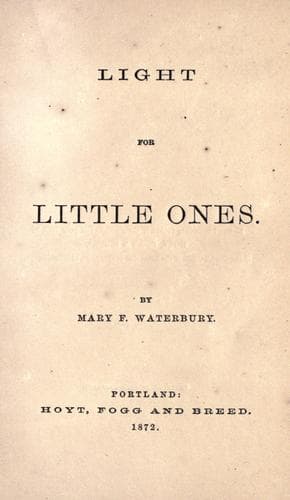
Children -- Conversion to Christianity -- Juvenile fiction; Children -- Religious life -- Juvenile fiction
“A father sent his little boy on a long journey, through a dark and
dangerous way; but before bidding him good-bye, he gave him a letter
which would tell him how to escape the dangers, and how to find the way
through the darkness. This is what he said to the child, who stood all
eagerness and haste to be gone.
“‘My child, you are just starting on your journey. You are full of life
and hope, and the way looks bright before you, but even in this broad,
sunny path, are many dangers; and, as you travel further, the path
narrows, the flowers are fewer, and the forest is darker; still further
on, are rocks, and underbrush, and pitfalls, and at the end of this
rough way is a dark and rapid river which you must cross. If you pass
over this stream safely, you will find yourself in a beautiful place. In
that land I will give you a home, and you shall live with me forever.’
“‘But how can I go all that dark way, father?’ and the boy’s face was
full of doubt and fear.
“The father handed him a letter, saying,
“‘This letter will tell you just what to do. Whenever you are in
trouble, look at this. Nothing can happen to you about which this will
not help you. But you are not to travel all the time. Every seventh day
you shall pause in your journey to rest and read this letter, and think
of all I have told you, and of the pleasant home to which you are going.
It will give you so much strength, and make your heart so light and
happy that you can travel faster and further than if you had not
stopped.’
“‘But need I stop at first, father, when the way is easy and I am not
tired?’ asked the boy.
“‘Oh yes, my child, or you will forget it by and by; then, though the
way be easy, it has dangers which you cannot avoid unless you study the
letter very carefully, and store it in your mind, so that you will know
what to do if danger comes suddenly. Therefore, my child, remember to
rest in your journey one day out of seven, read this letter, and think
of your father and the home beyond the river.’
Public-domain text, read in full here on John Shaqi.
Reviews
Reviews
No reviews yet
Be the first to share your thoughts on this work.
Join the Discussion
Join the discussion
Sign in to leave a comment or review.
Sign InorCreate an account