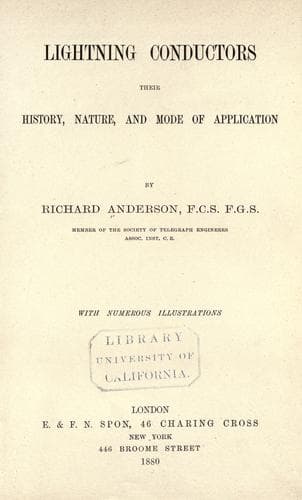
Lightning Conductors: Their History, Nature, and Mode of ApplicationAnderson, Richard, F.C.S.
History
Lightning Conductors: Their History, Nature, and Mode of Application
Anderson, Richard, F.C.S.
Lightning conductors
The terminal rod of the conductor generally projects about four feet
above the chimney or other highest point of the building. It consists
of a round iron rod seven-sixteenths of an inch in diameter, the lower
extremity being hammered out for the purpose of fastening it to the
conductor by soldering and screws or by bolts. A small building, not
exceeding twenty-five feet in length or breadth, is generally fitted
with either one terminal rod placed on the centre of the ridge of the
roof, or with two rods, one at each end of the ridge, the latter method
being the preferable one. In larger buildings terminal rods are placed
at intervals of about twenty feet along the roof. The upper end of
the rod is sometimes pointed, but not always, the argument being that
although the ordinary end of a rod is blunt when used in connection
with a Leyden jar, but that when applied to a thunder-cloud, which
extends over thousands of acres, it becomes pointed, and bears the
same proportion to a thunder-cloud as the sharp point of a needle does
to the hand of a man. Occasionally the point is tipped with platinum,
gold, silver, or pure copper, in order to prevent oxidation, but this
is not considered essential, it being presumed that, practically no
amount of rust on the top would impair the efficacy of the terminal rod.
In the case of a building having a flag-staff upon it, a galvanised
iron wire is fastened along it and projects about six inches above the
top, the lower end of the wire being of course carefully soldered or
otherwise connected with the main conductor.
Steeples and spires, in addition to the ordinary vertical conductor,
are fitted with horizontal conductors placed around them at intervals
of about twenty feet, and connected with the vertical conductor. This
is to provide against the occasional discharges that take place in
the centre of steeples, and which are caused by the deflection of the
discharge in the air by the rain.
Public-domain text, read in full here on John Shaqi.
Reviews
Reviews
No reviews yet
Be the first to share your thoughts on this work.
Elsewhere in the archive
Join the Discussion
Join the discussion
Sign in to leave a comment or review.
Sign InorCreate an account