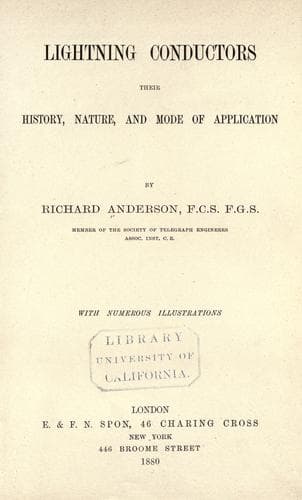
Lightning Conductors: Their History, Nature, and Mode of ApplicationAnderson, Richard, F.C.S.
History
Lightning Conductors: Their History, Nature, and Mode of Application
Anderson, Richard, F.C.S.
Lightning conductors
Chimneys and air shafts, from which heated air or smoke escapes,
are fitted with metallic caps which are connected with the general
conductor. In order to protect this metallic cap from the effects
of the sulphurous fumes arising from the chimney, a terra-cotta cap
is contrived to fit inside the metallic cap. An analogous method is
adopted with regard to the ventilators of barns and ice-houses. If
these buildings have the ordinary ventilators in the form of dormer
windows upon the roof, an iron rod seven-sixteenths of an inch in
diameter is placed vertically across, and above the centre of the
opening of each ventilator, and connected with the conductor. Should
the barn or ice-house have openings or doors through which warm vapour
can escape, a conductor is fixed to the roof at the gable ends above
the centre of each opening or door, and extended outwards about five
feet, at an angle of forty-five degrees from the roof, so as to be in
line with any ascending vapour, or any descending charge of electricity
following the course of the vapour. All these auxiliary conductors and
terminal rods are metallically connected with the main conductor of the
building.
The conductors are simply fastened to the building by iron staples or
by straps of sheet iron, pierced with two holes for nails or screws.
In America, as elsewhere, the earth-terminal is regarded as of prime
importance, and in all properly constructed lightning conductors
receives the greatest care and attention. In the first place, such
metal pipes as lead from the building to the water-mains, gas-mains,
and sewers are carefully connected with the principal lightning
conductor, in order that they may act as auxiliary earth-terminals.
For the principal earth-terminal many contrivances have been brought
forward, but very few possess any originality, and many are positively
useless. Some of the best are similar to those in use in England;
among others, perhaps the best method is that of placing a cast or
wrought-iron pipe of three inches inside diameter, and about ten feet
long, vertically in thoroughly moist earth and carefully connecting the
conductor, or conductors, with it. The chief objections to this plan
are the occasional difficulty of getting a moist earth at all, and the
possibility of earth that is generally moist getting dried up in hot
weather. To obviate these risks, the following arrangement is used:—
Public-domain text, read in full here on John Shaqi.
Reviews
Reviews
No reviews yet
Be the first to share your thoughts on this work.
Elsewhere in the archive
Join the Discussion
Join the discussion
Sign in to leave a comment or review.
Sign InorCreate an account