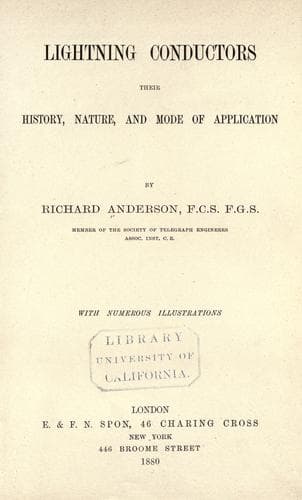
Lightning Conductors: Their History, Nature, and Mode of ApplicationAnderson, Richard, F.C.S.
History
Lightning Conductors: Their History, Nature, and Mode of Application
Anderson, Richard, F.C.S.
Lightning conductors
A few words may be added here on the method of protecting the large
mineral oil tanks which are to be found in the United States. Many of
these oil tanks are of very large capacity, some of them containing a
million gallons of oil. They are generally constructed of thick iron
plates rivetted together. The roofs are usually made of wood coated
with tar, but in some cases iron is adopted. As a rule, several of the
tanks are grouped together and connected with each other--and in some
instances with distilleries--by means of subterraneous iron pipes.
One method of protecting these tanks is to erect around them, at
a distance of some ten feet, wooden supports, on which are placed
upright metallic conductors which overlook the tank, and are connected
with each other near their tops by stout iron wires, thus forming a
network of conductor which is supposed to intercept any discharge of
electricity from a tempest-cloud, and prevent it from reaching the oil
tank. This method, however, has failed in several notorious instances,
and is not countenanced by the best authorities.
A better and less complex arrangement is now usually adopted by the
best firms. The chief object of this arrangement is to prevent the
temperature of the oil tank, and of the atmosphere above and around it,
being raised by means of an electric discharge. This is accomplished
by using large conductors, which are carried some distance above the
oil tank. These conductors, of which there should be at least four,
are formed of flat iron bars about one and a half inches wide and
half an inch thick; they are securely fastened to the sides of the
tank at equal distances from each other, and metallically connected
with it. About thirty feet above the roof of the tank they meet, and
are carefully and substantially joined together, and supported, if
necessary, by a wooden post extending from the centre of the roof of
the oil tank.
The earth terminals, of which there must be one to every two
conductors, consist of perforated iron pipes, as before described,
three inches in diameter and fifteen feet long. They are sunk into
thoroughly moist earth, and metallically connected with the lower part
of the tank. These perforated pipes are so arranged that they catch the
rain water from the roof of the tank; by this means the surrounding
earth is kept moist. It may be mentioned that by utilising the tank
as a portion of the system of conductors, the electric discharge is
distributed and much weakened.
CHAPTER XIII.
LIGHTNING PROTECTION IN ENGLAND.
Public-domain text, read in full here on John Shaqi.
Reviews
Reviews
No reviews yet
Be the first to share your thoughts on this work.
Elsewhere in the archive
Join the Discussion
Join the discussion
Sign in to leave a comment or review.
Sign InorCreate an account