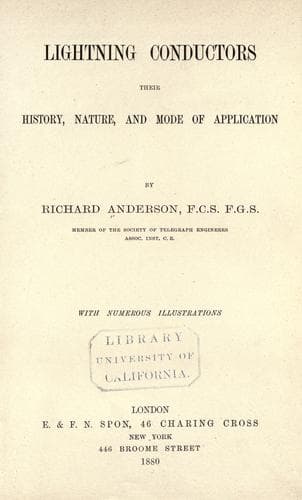
Lightning Conductors: Their History, Nature, and Mode of ApplicationAnderson, Richard, F.C.S.
History
Lightning Conductors: Their History, Nature, and Mode of Application
Anderson, Richard, F.C.S.
Lightning conductors
In its essence there cannot be anything more elementary than the theory
of protection against lightning. It is simply to lay a metallic line
from the top of a building, or other object to be protected, into moist
ground, so as to make a path for the electric force, along which,
not finding impediments, it will travel freely, without causing the
least damage. But, like many other simple theories, their practical
execution is not without perplexities. The first of these, in regard
to conductors, arises from the existence of more or less considerable
quantities of metals, to be found in almost every building which
requires protection against lightning. As the use of metals, especially
iron, in the construction of dwellings, both exterior and interior,
is rapidly extending, this becomes a very important consideration
in planning the design of lightning conductors. Of equal moment is
a second point--that of the existence of water or great moisture
under the buildings, or part of them. This must decide invariably
the direction of the conductor towards the earth, and its depth
underground. There are many minor matters to be taken into account, but
these two may be laid down as the chief questions to be kept in view
in settling the best mode of application of any conductors under given
circumstances. It happens often enough that a proper solution as to
what is best is not a little difficult. Still, it can always be arrived
at by careful study, which must, however, be aided by experience.
Public-domain text, read in full here on John Shaqi.
Reviews
Reviews
No reviews yet
Be the first to share your thoughts on this work.
Elsewhere in the archive
Join the Discussion
Join the discussion
Sign in to leave a comment or review.
Sign InorCreate an account