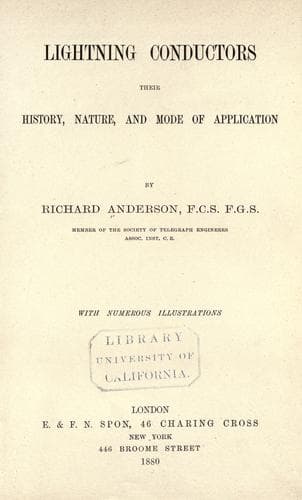
Lightning Conductors: Their History, Nature, and Mode of ApplicationAnderson, Richard, F.C.S.
History
Lightning Conductors: Their History, Nature, and Mode of Application
Anderson, Richard, F.C.S.
Lightning conductors
The system employed by Mr. R. S. Newall, F.R.S., for the construction
and erection of lightning conductors is probably the most complete--and
certainly the most representative--of the various methods in vogue in
England. The special study Mr. Newall has made of the subject in all
its bearings, both theoretical and practical, added to the fact of his
possessing at his extensive cable works at Gateshead such exceptional
facilities for the production of copper ropes and bands composed of the
purest metal, render him one of the first authorities on all matters
connected with the application of lightning conductors to buildings. In
describing, therefore, the English method, reference will chiefly be
made to this gentleman’s apparatus and inventions.
The function of a lightning conductor is twofold. In the first
instance, it operates as a medium by which explosions of lightning,
or, to speak more accurately, disruptive discharges of electricity,
are led to the earth freely, and without the risk of their acting
with mechanical force, as they invariably do when compelled to pass
on their way to the earth through so-called non-conductors, that is
to say, bodies possessed of low conductivity, such as the atmosphere,
wood, stone, &c. In the second instance, the conductor acts as a means
whereby the accumulation of electricity existing in the atmosphere
is quietly drawn off and carried noiselessly into the earth, and
dissipated in the subterraneous sheet of water beneath it. Now this
accumulation of electricity, always greatly intensified during a
thunderstorm, invariably seeks the easiest road to earth; this road is
technically called ‘the line of least resistance.’ This line of least
resistance is influenced by various circumstances; the resistance of
any line may be lessened by the presence of streams of warm vapour or
rarefied air such as would come from chimneys, from barns or stacks
containing new hay; by a column of smoke, or by the presence of tall
trees moist from rain. It is not always easy to find the reason why
the lightning takes any particular path, but one thing is certain,
that is, it acts under certain fixed principles, and does not take any
particular route by chance, but always because it is the line of least
resistance. What the lightning conductor really does is to prevent the
possibility of an electric discharge within a certain district, for
instance, in the interior of a house or other building.
Public-domain text, read in full here on John Shaqi.
Reviews
Reviews
No reviews yet
Be the first to share your thoughts on this work.
Elsewhere in the archive
Join the Discussion
Join the discussion
Sign in to leave a comment or review.
Sign InorCreate an account