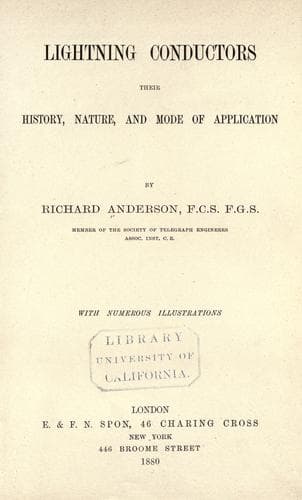
Lightning Conductors: Their History, Nature, and Mode of ApplicationAnderson, Richard, F.C.S.
History
Lightning Conductors: Their History, Nature, and Mode of Application
Anderson, Richard, F.C.S.
Lightning conductors
Keeping always in view the fact that there is nothing whatever that
may be called ‘erratic’ in the manifestations of the electric force,
but that it acts under a ruling principle as strict as that governing
the law of gravity, the first point in designing the protection of any
building will be to clearly ascertain what path the lightning will take
on its course from the clouds to the earth. It is absolutely certain
that the electric force will make its way through materials, termed
good conductors, which allow it free passage, and avoid those of the
opposite class, or bad conductors, the character of every substance on
earth being well known as regards these qualifications, although it
would not be easy to draw sharp lines of demarcation, all conductivity
being relative and not absolute. Looked at in this way, the fundamental
one in the application of lightning conductors, the simplest object for
protection will be a pyramid of stone, such as the Egyptian obelisk,
popularly called ‘Cleopatra’s Needle,’ erected on the Thames Embankment
in the summer of 1878. Stone being a bad conducting material, all that
is necessary to protect it against lightning, provided there is no
metal whatever near it, is to run a thin strip or rope of copper from
the summit to the base, and down into moist earth. Although fragile,
the strip of copper, if uninterrupted and rooted in moisture, will in
this case form an absolute protection. The question assumes another
aspect if, instead of a stone pyramid, a tall factory chimney, not
very dissimilar in outward form, is given as an object for protection.
Here there enters another element. A tall pile of bricks is as bad a
conductor of electricity as a solid mass of stone, but the mass of
bricks constituting a factory chimney is hollow, and the cavity being
filled with smoke and mineral fumes, which are more or less good
conductors of the electric force, the artificial path laid for the free
passage of lightning has to surpass in acceptability the natural one.
In other words, the copper rod laid alongside the factory chimney, to
secure it against damage from lightning, must be considerably thicker
than the one which will protect the simple stone pyramid. It is this
principle which has to be followed all through in the application
of conductors. They must form, in one word, the best path which can
possibly be made for the electric force.
Public-domain text, read in full here on John Shaqi.
Reviews
Reviews
No reviews yet
Be the first to share your thoughts on this work.
Elsewhere in the archive
Join the Discussion
Join the discussion
Sign in to leave a comment or review.
Sign InorCreate an account