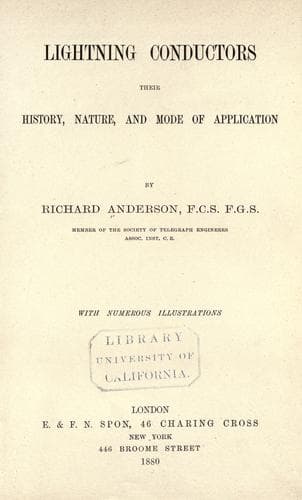
Lightning Conductors: Their History, Nature, and Mode of ApplicationAnderson, Richard, F.C.S.
History
Lightning Conductors: Their History, Nature, and Mode of Application
Anderson, Richard, F.C.S.
Lightning conductors
A case in point occurred in May 1879. The steeple of the church at
Laughton-en-le-Morthen was struck by lightning and damaged, the
lightning conductor being thrown down and broken into two pieces. A
correspondence on the subject ensued in the _Times_, and Mr. R. S.
Newall had the remains of the conductor examined, with the following
result:
‘The spire is 175 feet in height, and it had attached to it a thin
tube, made of corrugated copper, about seven-eighths of an inch in
external diameter and five-eighths internal. The copper is about
one-thirty-second of an inch in thickness, and it weighs about one and
a quarter pound per yard. It is made in short lengths, joined together
by screws and coupling pieces, but there is no metallic contact
whatever between the pieces, which are much corroded.
‘The conductor appeared to be fastened to the vane. It was not in
contact with the building, which it ought to have been, but it was kept
at a distance of about two-and-a-half inches from it by twenty-one
insulators. The earth contact was obtained by bending the tube and
burying it in the ground at a depth of from six inches to eighteen
inches, the soil being dry loose rubbish; the length of the earth end
was only three feet, with two short pieces of about a foot in length
each tied to the tube by thin wires, thus forming altogether a most
inefficient conductor. It was placed in a corner formed by a double
stone buttress, which came between the conductor and a lead-covered
roof attached to the spire, the distance between the conductor and the
lead roof being about six feet six inches.
‘The lightning appears to have come down the conductor a certain
distance, and, finding the road to earth bad, it passed through the
buttress, dislodging about two cart-loads of stone, and then came down
the cast-iron down pipes leading from the lead-covered roof and so to
earth.’
Mr. Newall, in writing to the _Times_, goes on to say:—
‘Now if the conductor had been made of copper-wire rope, weighing about
two pounds per yard, and fixed in contact with the spire, without
insulators and with a proper earth contact, no damage whatever would
have been sustained by the building; and if the conductor had been
tested periodically by an expert he would have shown whether the
conductor was good or useless. This examination ought to be insisted
on, as the earth connection is often wilfully destroyed; but I have
never in all my experience known a building which had a conductor
properly fixed to suffer damage from lightning.’
What is really required is to make a lightning conductor of sufficient
calibre to carry down the electric discharge, however great it may be,
from the summit of the building into the earth, and that the earth
contact should be above suspicion and thoroughly good in all seasons.
[Illustration: Fig. 26.]
[Illustration: Fig. 27.]
[Illustration: Fig. 28.]
Public-domain text, read in full here on John Shaqi.
Reviews
Reviews
No reviews yet
Be the first to share your thoughts on this work.
Elsewhere in the archive
Join the Discussion
Join the discussion
Sign in to leave a comment or review.
Sign InorCreate an account