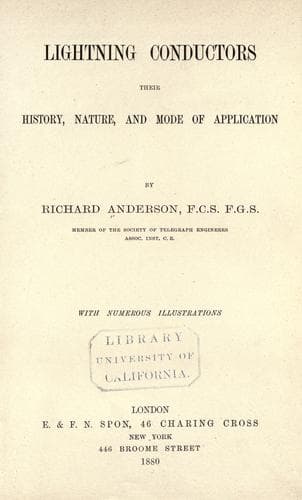
Lightning Conductors: Their History, Nature, and Mode of ApplicationAnderson, Richard, F.C.S.
History
Lightning Conductors: Their History, Nature, and Mode of Application
Anderson, Richard, F.C.S.
Lightning conductors
There are, in the records of scientific discovery, few figures so
interesting, because so full of marked individualism, as that of
Benjamin Franklin. He was not a man of genius, in the accepted sense
of the word; nor was he even a man of high talents. But he was
nevertheless a decidedly great man, his greatness consisting in the
largest development of that undefined faculty known as common sense.
Benjamin Franklin was the very ideal of a ‘practical’ man, that is,
a man valuing thoughts only as leading to actions, and new ideas
only as the road to visible results. The success of his career in
life was but an illustration of his thoroughly practical character.
Born at Boston in January 1706, the son of a tallow-chandler and
soap-boiler, he was destined by his parents to follow the same trade,
but not relishing the melting pots, he got apprenticed to an elder
brother, a printer at Boston. Harsh treatment drove him away from
this place before the terms of his apprenticeship were over, and with
scarcely a penny in his pocket, and the experience of only seventeen
years in his brain, he made his way to Philadelphia. A year after,
when eighteen years of age, he was induced to sail for England, and
was fortunate enough to find employment as a compositor in a printing
office in London, but so poor as to be compelled to take a lodging
for eighteen-pence a week. However, his self-reliance never deserted
him; he managed to go unscathed through all the perils of poverty and
friendlessness in a great city, and after a few years went back to
Philadelphia, with a small stock of money and a wealth of experience.
He now set up as a master printer, and gradually, though by very slow
degrees and ceaseless toil, devoted to multifarious objects, rose into
prosperity. For upwards of twenty years, from 1728 to 1748, he was the
most energetic and active man of business in Philadelphia. He was not
only a printer, but an author, an editor of newspapers, a compiler of
almanacks, a publisher, a bookseller, a bookbinder, and a stationer.
He made lamp-black and ink; he dealt in rags; he sold soap and geese
feathers; also, as he frequently made known to his fellow-townsmen
in printed notices, he had always in stock ‘very good sack at six
shillings a gallon.’ To dispose of the numerous articles in his store
he invented the art of advertising, unknown before him at Philadelphia.
All the inquiring minds of the ‘Quaker City’ assembled regularly in the
shop of Benjamin Franklin, ‘the new printing office near the market,’
which came to form the centre of intelligence, and the source from
which all public movements went forth.
Public-domain text, read in full here on John Shaqi.
Reviews
Reviews
No reviews yet
Be the first to share your thoughts on this work.
Join the Discussion
Join the discussion
Sign in to leave a comment or review.
Sign InorCreate an account