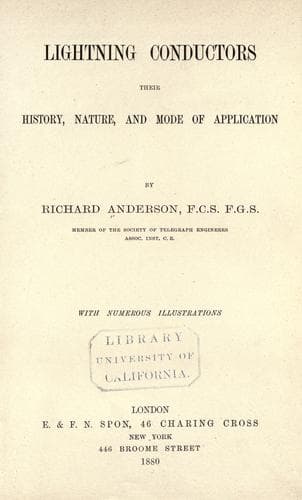
Lightning Conductors: Their History, Nature, and Mode of ApplicationAnderson, Richard, F.C.S.
History
Lightning Conductors: Their History, Nature, and Mode of Application
Anderson, Richard, F.C.S.
Lightning conductors
‘An electric discharge cannot occur between two bodies unless the
difference of their potentials (i.e. their electrical conditions)
is sufficiently great, compared with the distance between them. If,
therefore, we can keep the potentials of all bodies within a certain
region equal, or nearly equal, no discharge will take place between
them. We may secure this by connecting all these bodies by means of
good conductors, such as copper wire ropes, but it is not necessary
to do so, for it may be shown by experiment that if every part of the
surface surrounding a certain region is at the same potential, every
point within that region must be at the same potential, provided no
charged body is placed within the region.
‘It would therefore be sufficient to surround our powder-mill with a
conducting material, to sheath its roof, walls, and ground-floor with
thick sheet-copper, and then no electrical effect could occur within
it on account of any thunderstorm outside. There would be no need of
any earth connection. We might even place a layer of asphalt between
the copper floor and the ground, so as to insulate the building. If
the mill were then struck with lightning, it would remain charged for
some time, and a person standing on the ground outside and touching the
wall might receive a shock, but no electrical effect would be perceived
inside, even on the most delicate electrometer. The potential of
everything inside with respect to the earth would be suddenly raised or
lowered as the case might be; but electric potential is not a physical
condition, but only a mathematical conception, so that no physical
effect would be perceived.
Public-domain text, read in full here on John Shaqi.
Reviews
Reviews
No reviews yet
Be the first to share your thoughts on this work.
Elsewhere in the archive
Join the Discussion
Join the discussion
Sign in to leave a comment or review.
Sign InorCreate an account