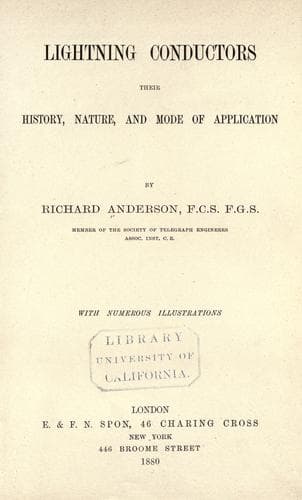
Lightning Conductors: Their History, Nature, and Mode of ApplicationAnderson, Richard, F.C.S.
History
Lightning Conductors: Their History, Nature, and Mode of Application
Anderson, Richard, F.C.S.
Lightning conductors
It is not very clear from the published correspondence of Franklin what
his earliest views on the subject were, but there are many indications
that he conceived for a while that the ‘electric fire’ might be
employed in arts and manufactures. In his usual humorous style he spoke
of these utilitarian aims of his in a letter to Mr. Peter Collinson,
written in the early summer of 1747: ‘Chagrined a little that we
have not been able to produce hitherto anything in the way of use to
mankind,’ he wrote, ‘and the hot weather coming on, when electrical
experiments are not so agreeable, it is proposed to put an end to them,
for this season, in a party of pleasure on the banks of the Schuylkill.
Spirits at this party are to be fired by a spark sent from side to
side through the river, without any other conductor than the water:
an experiment which we some time since performed, to the amazement of
many. Then a turkey is to be killed for our dinner by the electrical
shock, and roasted by the electrical jack, before a fire kindled by the
electrified bottle, when the healths of all the famous electricians in
England, Holland, France, and Germany are to be drunk in electrified
bumpers, under the discharge of guns from the electrical battery.’
The longer he experimented, the more fascinated grew Benjamin Franklin
with his study of the phenomena of electricity. In order to be able to
devote himself completely to his darling science, he sold his printing
and publishing business in the year 1748, and went to live in a suburb
of Philadelphia, not far from the banks of the Delaware. At the same
time he purchased a complete set of electrical apparatus, the best that
had yet been manufactured, which had been brought over from Europe by
the same Dr. Spence who had given him his first ideas about electricity
at Boston. With these more perfect means he now continued his
investigations, arriving before long at results that formed an epoch in
the history of electricity.
Public-domain text, read in full here on John Shaqi.
Reviews
Reviews
No reviews yet
Be the first to share your thoughts on this work.
Join the Discussion
Join the discussion
Sign in to leave a comment or review.
Sign InorCreate an account