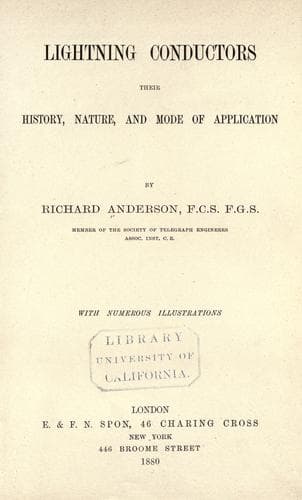
Lightning Conductors: Their History, Nature, and Mode of ApplicationAnderson, Richard, F.C.S.
History
Lightning Conductors: Their History, Nature, and Mode of Application
Anderson, Richard, F.C.S.
Lightning conductors
To dwell too largely upon the importance of leading all lightning
conductors down into moist earth, or, as technically called, ‘good
earth,’ would be scarcely possible. It would perhaps not be too
strong an expression to say that the part of the conductor above
ground is a mere appendage to that under ground, the essential
function of the whole apparatus--that of dispersing the electric force
harmlessly--being accomplished by the subterranean portion. The clear
understanding of Benjamin Franklin perceived this at the outset;
but after him it seemed as if forgotten for a long time, and the
result showed itself in numerous disasters that occurred to buildings
protected with conductors, which brought the latter into disrepute with
many persons. While, no doubt, in many instances the cause of these
disasters was in the bad application of the conductors themselves,
their defective character, or their feebleness, still in the great
majority the underground connection may be taken to have been in
fault. It may be laid down as an absolute certainty that a really good
conductor--say, a copper rope from five-eighths to three-quarters of an
inch in thickness--cannot possibly fail to carry off the electric force
if the lower part reaches moist earth or water. Probably, in nine cases
out of ten, whenever a building provided with a conductor is struck by
lightning, it is for want of ‘good earth.’
Franklin’s own ideas were very clear on the subject. He laid them
down at various times, more particularly when residing in England,
during the years from 1764 to 1775, as colonial agent for Pennsylvania.
During the latter part of this period he took an active interest in the
proceedings of the Royal Society; and this learned body being requested
by the Government to give advice regarding the best protection against
lightning that could be provided for the great powder magazines at
Purfleet, he was nominated into a committee with three other members,
William Watson, H. Cavendish, and J. Robertson. The committee drew up
a report, dated August 21, 1772, signed by all the members, but known
to be written by Franklin alone. Dwelling strongly on the importance of
the underground connection, Franklin says in this report: ‘In common
cases it has been judged sufficient if the lower parts of the conductor
were sunk three or four feet into the ground, till it came to moist
earth; but this being a case of great consequence, we are of opinion
that greater precaution should be taken. Therefore we would advise that
at each end of each magazine a well should be dug, in or through the
chalk, so deep as to have in it at least four feet of standing water.
From the bottom of this water should rise a piece of leaden pipe to, or
near, the surface of the ground, where it should be joined to the end
of an upright bar.’ Franklin then goes on to recommend the usefulness
of having even more wells than the two, so as to avoid any possibility
of failure in protecting the powder magazines.
Public-domain text, read in full here on John Shaqi.
Reviews
Reviews
No reviews yet
Be the first to share your thoughts on this work.
Elsewhere in the archive
Join the Discussion
Join the discussion
Sign in to leave a comment or review.
Sign InorCreate an account