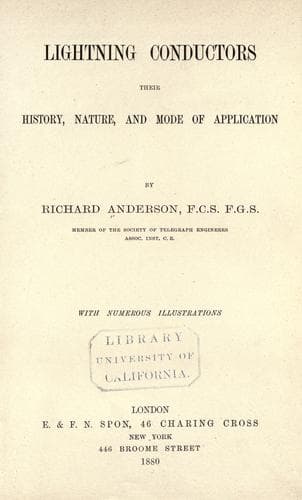
Lightning Conductors: Their History, Nature, and Mode of ApplicationAnderson, Richard, F.C.S.
History
Lightning Conductors: Their History, Nature, and Mode of Application
Anderson, Richard, F.C.S.
Lightning conductors
‘We also advise,’ he
says in his report, ‘in consideration of the great length of the
buildings, that two wells of the same depth with the others should be
dug within twelve feet of the doors of the two outside magazines--that
is to say, one of them on the north side of the north building, and the
other on the south side of the south building, from the bottom of which
wells similar conductors should be carried up.’ It is not on record
whether these recommendations were adopted by the Government, but it
seems likely that this was the case, as the fear of explosion of powder
magazines through a stroke of lightning was very great at the time. Not
long before, a magazine had been so destroyed at Brescia, in Italy,
with the appalling result of a considerable part of the city being laid
in ruins, burying many hundreds of persons. The destruction of the
Brescia powder magazine, like all similar events, had, it is scarcely
necessary to say, its due effect in spreading a desire for lightning
conductors, fear doing what was not effected by foresight.
Whether or not the English Government made the wells recommended by
Franklin for the Purfleet powder magazine, it is certain that the
sound advice given was not largely followed. On the contrary, there
grew a generally prevailing laxity in regard to the indispensableness
of a good underground connection, which led to numerous accidents.
They were seldom, however, ascribed to the right cause, others being
sought instead--such as particular forms of conductors and the
insufficient length of those phantoms called ‘reception-rods,’ which,
as many thought, could never be made high enough, in order to ‘draw
the electric fluid’ from the clouds. Height was sought where nothing
but depth was required, and the same unsightly rods, towering high
above buildings, would have very effectually carried off the electric
forces if brought from the top to the bottom of the conductor, being
taken out of the air and stuck into the earth. Still, there were
not wanting philosophical minds impressed with the truth that no
lightning conductor can discharge its functions unless rooted in
moisture, and who not only knew it, but did their best to spread this
knowledge in all directions. One of these philosophers, a singular
character in his way, was a German clergyman, the Rev. Dr. Hemmer,
who lived at Mannheim, on the Rhine, at the end of the last century.
Taking the deepest interest in Franklin’s great discovery, he made
many experiments with lightning conductors, which brought him to the
conviction that the electric force, in its chief tendency, seeks
the mass of water on the globe, and that where this is not on the
surface, it must be guided to it to become harmless. Consequently, he
recommended to sink the conductor invariably deep into the ground, so
as to reach water, and to subordinate everything else to this prime
necessity. To make the use of lightning conductors as general as
possible, Dr.
Public-domain text, read in full here on John Shaqi.
Reviews
Reviews
No reviews yet
Be the first to share your thoughts on this work.
Elsewhere in the archive
Join the Discussion
Join the discussion
Sign in to leave a comment or review.
Sign InorCreate an account