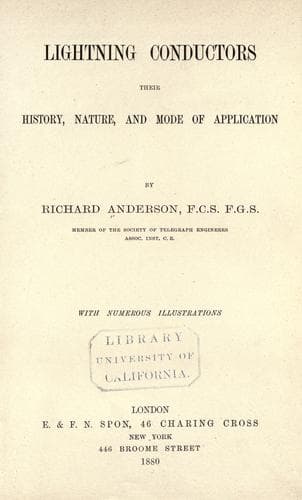
Lightning Conductors: Their History, Nature, and Mode of ApplicationAnderson, Richard, F.C.S.
History
Lightning Conductors: Their History, Nature, and Mode of Application
Anderson, Richard, F.C.S.
Lightning conductors
‘It so happened that four years after the erection of the conductor
a line of pipes was laid down to carry water to the towns of Alatri
and Ferentino, passing at a short distance from the belfry of the
cathedral. The lightning conductor was not placed in communication with
the pipes, because it seemed established, from previous experiments
and observations, that it was needless to do so, the ground containing
apparently sufficient moisture, the head of the waterworks being close,
and there existing also a running fountain. I was not asked at the time
whether it was necessary to establish this communication, but, had the
question been put to me, I should probably have answered it in the
negative, considering, from what I then knew, the work as superfluous.
That I was in error then as to the necessities of a perfect underground
connection is shown by what happened during the great storm in the
early morning of October 2. The heavy flash of lightning before
referred to did not go its appointed path underground, but passed off
into the waterworks, with the following results:—
‘1. It made in the earth a perfectly rectilinear excavation, which,
from the lower part of the conductor, went to the tube of the
waterworks running to Ferentino, and in traversing the wall destroyed
the angle of that structure. The earth of the ditch thus dug was
disposed regularly to right and left with great symmetry. The length
of the ditch was about 10 metres, the depth about 70 centimetres [28
inches].
‘2. The lightning struck the water-pipe of Ferentino, broke it
completely, throwing the pieces to a distance of about 80 centimetres
[32 inches]. The lead which soldered the joint of the broken tube with
the tube beyond was found melted. In consequence of this rupture the
water ceased flowing to Ferentino, and poured into the waterworks.
‘3. Another part of the discharge spread itself by the pipe which goes
to Alatri, and traversing the reservoir threw to a great distance
some wooden plugs which stopped up the discharging tubes, the plugs
being forcibly hammered in. It arrived at the town in a tank, where it
damaged and twisted in a strange manner a leaden slab which was in the
tank, made some other little injuries, and finally left the trace of
its passage at the spouts of the public fountain.
Public-domain text, read in full here on John Shaqi.
Reviews
Reviews
No reviews yet
Be the first to share your thoughts on this work.
Elsewhere in the archive
Join the Discussion
Join the discussion
Sign in to leave a comment or review.
Sign InorCreate an account