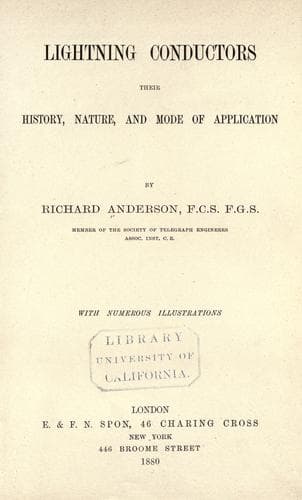
Lightning Conductors: Their History, Nature, and Mode of ApplicationAnderson, Richard, F.C.S.
History
Lightning Conductors: Their History, Nature, and Mode of Application
Anderson, Richard, F.C.S.
Lightning conductors
‘In order to remedy this defect, that part of the conductor which
enters the ground has been made very long, more than 4 metres [13
feet], and has been provided with a great many couples of points, 5
centimetres [2 inches] broad, 5 millimetres [⅛ inch] thick, indentated
on the edges, with the addition of a thick copper wire twisted among
the same points, to help to multiply the points of contact between the
rod and the carbon. The foot of the lightning conductor is entirely
of copper. The rod is also of copper up to a metre [3¼ feet] above
the ground; and there is joined to it the iron conductor, in the
ordinary receptacle made in the heart of the wall, to preserve it from
disturbances of the inferior parts. The ditch into which the foot of
the lightning conductor was sunk is 5 metres [·16 feet] long, and
half-a-metre [1⅝ feet] wide, and it was dug into the ground as far
as to touch the roots of some neighbouring trees, from which point
upwards a layer of cinders was placed, covering the greater part of the
ditch. Thus the surface of contact between the metal and the carbon,
and of the latter with the soil, was such that one would have supposed
it to be more than sufficient, while the presence of trees, although
they were not very large, made it highly probable that the ground did
always contain sufficient moisture. Moreover, as the edifice had two
culminating points--namely, the belfry and the raised back portion of
the choir--two rods were placed on them, each having an independent
connection with the earth, so that, in the case of a discharge on one
of the points, the electric force might find two ways in its course
towards the earth.
‘These arrangements produced, on the whole, a good result, since,
although the edifice was struck at least four times after conductors
had been placed on it, it suffered no damage of any kind. Nevertheless
a very curious accident, highly interesting as a scientific study,
happened on October 2. Early on the morning of this day several flashes
of lightning fell down from the clouds during a terrific storm,
which lasted over two hours. The belfry was struck at first by weak
discharges twice; but the third flash was so appalling in its strength
as to terrify the whole town below. The injuries it caused were not
great, still they seemed to me to be extremely noteworthy. But before
I describe them I must give some necessary details as to place and
position of the lightning conductor.
Public-domain text, read in full here on John Shaqi.
Reviews
Reviews
No reviews yet
Be the first to share your thoughts on this work.
Elsewhere in the archive
Join the Discussion
Join the discussion
Sign in to leave a comment or review.
Sign InorCreate an account