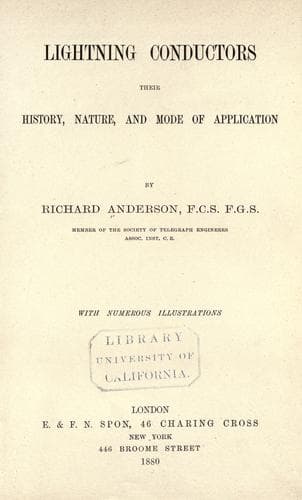
Lightning Conductors: Their History, Nature, and Mode of ApplicationAnderson, Richard, F.C.S.
History
Lightning Conductors: Their History, Nature, and Mode of Application
Anderson, Richard, F.C.S.
Lightning conductors
Among the many interesting remarks of Dr. Holtz, evidently based on a
thorough knowledge of the subject which he treats, are some good ones
about the necessity of constructing lightning conductors, not slavishly
after old models, but in conformity with modern requirements, carefully
considering the nature of the buildings to be protected and their
materials. ‘The increase of metals,’ he says, ‘in the construction
of houses, both inside and outwardly, is assuming larger proportions
from year to year. An absolute consequence of it is, that the electric
force called lightning is tempted, far more than was the case in older
dwellings, not to go to the conductor at all, or, if attracted to
it, to leave the path afterwards, seeking other attractions. I found
this to have been the case, in the course of my investigations, in
several instances, two of them notable ones. The first was that of the
public school of the town of Elmshorm, struck by lightning away from
the conductor; and the second that of the church of St. Lawrence, in
the town of Itzehoe, where the conductor was struck at first, but the
lightning deviated subsequently from its metal path. In both cases I
found that the non-efficacy of the conductor was caused by a number of
gas-pipes. But there are many other metallic masses besides gas-pipes
which interfere thus with the proper action of lightning conductors.
More or less, all metals do so, especially those which lead to the
ground, or are in contact with moisture. Water-pipes will attract
the electric force even more than gas-pipes, and likewise the metal
tubes which carry the rain from the roof into the ground. But it may
also happen that mere ornaments on the roof, more particularly if of
thick metal, and carried all along the top and sides, may divert the
electric force from the conductor, although they have no connection
whatever with the ground. Even the many wires outside and inside
houses, for bells and other purposes, may do mischief. There can be
no doubt whatever that the large increase of the use of metals in the
construction and ornamentation of modern houses has led to far greater
danger to which they are exposed from lightning. At the same time
there is equally little doubt that all this increased danger may be
absolutely guarded against by the setting up of lightning conductors
by competent persons, carefully designed to meet all cases.’ Dr. Holtz
adds, further on, that one most important element of protection to
be obtained from conductors consists in the regular testing of them,
without which, indeed, there can be no permanent security.
Public-domain text, read in full here on John Shaqi.
Reviews
Reviews
No reviews yet
Be the first to share your thoughts on this work.
Elsewhere in the archive
Join the Discussion
Join the discussion
Sign in to leave a comment or review.
Sign InorCreate an account