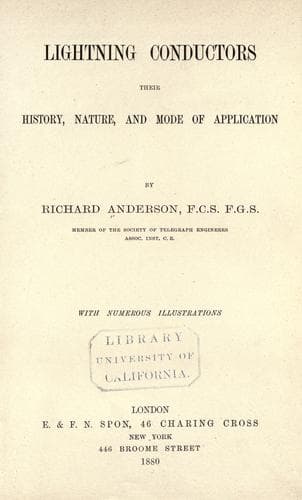
Lightning Conductors: Their History, Nature, and Mode of ApplicationAnderson, Richard, F.C.S.
History
Lightning Conductors: Their History, Nature, and Mode of Application
Anderson, Richard, F.C.S.
Lightning conductors
What the writer says on the inspection of conductors is particularly
worth quoting. ‘A lightning conductor,’ he remarks, ‘however excellent
in the first instance, may lose all its good qualities, for several
reasons. In the first instance it may suffer, like all mundane things,
from age. The decrepitude will come on all the sooner whenever the
materials are not of the best kind, or whenever little care has been
taken in properly connecting the various parts. This is frequently
the case in conductors of old design. But, even if all has been done
that scientific skill can accomplish, age will make itself felt some
time or other. Oxidation will play its part; so will the warfare of
the elements. However safely secured at first, the attachment of the
parts to the buildings will get loose, or perhaps even broken. Repairs
consequently become indispensable. When are they to be effected? It
can only be indicated by testing the conductor from time to time.’
Dr. Holtz next dwells at some length on the necessity of conductors
being designed by thoroughly competent persons; not mere ‘lightning
rod men,’ who are able to take into account all the particulars of the
building which is to be protected, more especially the metal employed
in the construction. ‘A conductor,’ he truly remarks, ‘cannot be
expected to be a trustworthy protection against the destructive force
of lightning, if simply set up over a house without consideration of
its outer and inner features. Perhaps in buildings of olden times, into
the construction of which metals seldom or never entered, a simple
wire running from top to bottom, surmounted by an iron rod, was quite
sufficient, but this is no longer the case, all the circumstances
having been completely altered. The wire, however thin, was not merely
the best, but the only path for the electric force. But at present
the masses of metal used in the construction of buildings constitute
a number of rival paths, and it requires very careful consideration
indeed to lay down an absolutely infallible lightning conductor in such
a way as to overcome all influences opposing its action. Therefore
conductors of old construction can not only not be expected to be
efficacious under modern exigencies, but even those made at the present
time cannot be expected to be efficient under circumstances which,
probably, the future may bring forth. There is really nothing else to
make a lightning conductor a safe protection under all circumstances,
and at all times, but regular, constant, and skilful examination.’
Public-domain text, read in full here on John Shaqi.
Reviews
Reviews
No reviews yet
Be the first to share your thoughts on this work.
Elsewhere in the archive
Join the Discussion
Join the discussion
Sign in to leave a comment or review.
Sign InorCreate an account