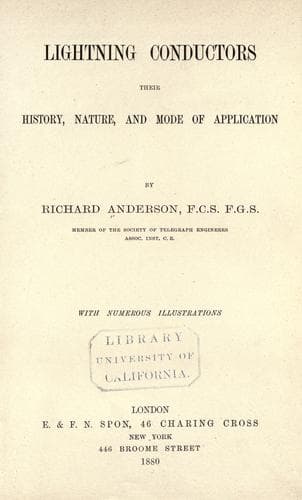
Lightning Conductors: Their History, Nature, and Mode of ApplicationAnderson, Richard, F.C.S.
History
Lightning Conductors: Their History, Nature, and Mode of Application
Anderson, Richard, F.C.S.
Lightning conductors
To the three great causes before indicated which make the regular
testing of conductors an almost imperative necessity, several minor
ones may be added. Among them may be cited the frequency of repairs
of the walls and roofs of houses. Our modern houses, as we all know,
are not built, like those of the Romans, ‘for an eternity,’ but in the
vast majority, particularly in towns, are ‘leaseholds for ninety-nine
years.’ Many of them, perhaps, can scarcely be expected to last
ninety-nine years, being constructed by their builders on the principle
of Peter Pindar’s razors, ‘not to shave, but to sell.’ Hence the
absolute necessity of repairs without end. Without casting the least
slur upon the character of the artisans who execute these, bricklayers,
plasterers, painters, plumbers, and others, it may be fairly asserted
that they are densely ignorant as to the nature of lightning
conductors. It is not at all a wonder that this should be so, since
they share their ignorance with many persons of far higher education,
who know no more of the action of the electric force in seeking its
way from the clouds into moist earth than they do of that of a voltaic
apparatus, or of a condensing steam-engine. These artisans, then, in
whose hands the repairs of houses are left, naturally treat the narrow
strip of metal running from the top of houses to the bottom with great
indifference, not having the slightest idea of its being one of the
most marvellous conceptions of the human mind. It has been reported,
on good authority, that there are frequently workmen to be found, such
as house painters and others, whose business it is to ‘decorate’ the
outside of dwellings with the stuff called ‘stucco,’ who feel a sort
of mild hatred for lightning conductors, as interfering with their
achievements, and, as they think, disfiguring the beauties which they
are creating. Woe to the poor conductor within their reach! Unless very
conspicuously placed, which is rarely the case, the tenant of a house
will seldom discover in time that the slender rope, or ribbon, which
gives him and his family protection against lightning has been broken
by cunning hands when the last repairs were effected, and the ends
stowed away in the gutter on the roof. The discovery will be made, in
the absence of inspection, probably, only under the fierce light of a
flash of lightning from a passing thunderstorm.
Public-domain text, read in full here on John Shaqi.
Reviews
Reviews
No reviews yet
Be the first to share your thoughts on this work.
Elsewhere in the archive
Join the Discussion
Join the discussion
Sign in to leave a comment or review.
Sign InorCreate an account