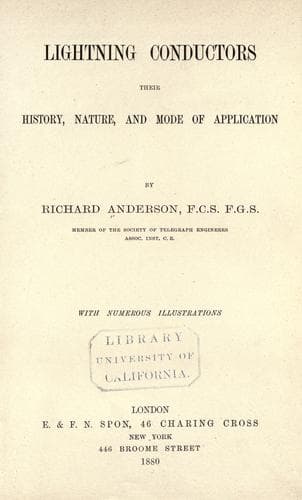
Lightning Conductors: Their History, Nature, and Mode of ApplicationAnderson, Richard, F.C.S.
History
Lightning Conductors: Their History, Nature, and Mode of Application
Anderson, Richard, F.C.S.
Lightning conductors
A rather ludicrous incident, and which gave rise to a great deal of
scientific tournamenting, added to the celebrity of Franklin’s little
book on the continent of Europe. The greatest of French electricians,
Abbé Nollet, a man of acknowledged merit, but inordinately vain,
was mystified in believing that the pamphlet which caused such an
immense stir at court and among the public was not the production
of the obscure man Franklin of Philadelphia, but got up among his
enemies in England and France, to rob him of his reputation. With this
belief fixed in his mind, he sat down at his desk to write a series
of letters intended to demolish the man of Philadelphia, and proving,
entirely to his own satisfaction, first, that Franklin did not exist
at all; secondly, that he had no right to exist; and thirdly, that
all his pretended discoveries were mere dreams. Not long after the
publication of his letters, the wrathful Abbé received undoubted proofs
from America that at Philadelphia there was a man called Franklin,
who himself mildly asserted his right not only to live, but to make
experiments in electricity. Poor Abbé Nollet felt his humiliation all
the more keenly as holding the post of preceptor in Natural Philosophy
to the royal family of France, and he had to suffer from a ‘burst of
inextinguishable laughter’ at one of his appearances at court.
If Count de Buffon did great service to electrical science by getting
Franklin’s pamphlet translated into French, he did still more by
instigating a series of experiments tending to verify the great theory
put forward in the pamphlet, that lightning could be drawn from the
clouds by means of pointed iron rods. By his prompting, several
gentlemen interested in scientific pursuits engaged upon trials to this
effect, among them two persons of note, M. Dalibard and M. de Lor.
The first-named had the good fortune to be successful, and thereby to
hand his name down to posterity. A wealthy man of science, M. Dalibard
was in the habit of living, during a part of the year, in a handsome
country house situated at Marly-la-Ville, about eighteen miles from
Paris, on the road to Pontoise. Marly-la-Ville stands on a high plain,
some four hundred feet above the sea-level, and the residence of M.
Dalibard being situated on the most elevated part of the ground, it
formed an excellent place for experiments, and was chosen as such by
Count de Buffon. The garden near the house was selected as the best
ground for the experiments. A wooden scaffolding was built up to hold
in its midst an iron rod, eighty feet long, and slightly over an inch
in diameter. On the top of the rod was fastened a piece of polished
steel, sharply pointed, and bronzed to prevent rust. The iron rod
entered, five feet from the ground, into another thinner one, running
horizontally towards an electrical apparatus, fastened to a table in
a kind of sentry-box, erected on purpose for observations. It was
M.
Public-domain text, read in full here on John Shaqi.
Reviews
Reviews
No reviews yet
Be the first to share your thoughts on this work.
Join the Discussion
Join the discussion
Sign in to leave a comment or review.
Sign InorCreate an account