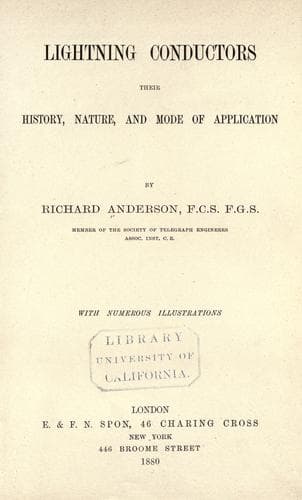
Lightning Conductors: Their History, Nature, and Mode of ApplicationAnderson, Richard, F.C.S.
History
Lightning Conductors: Their History, Nature, and Mode of Application
Anderson, Richard, F.C.S.
Lightning conductors
All Europe soon rang with the report of the marvellous discovery
verified at Marly-la-Ville. But before the news of the experiment
made at the village near Paris had reached America, Benjamin Franklin
had made another, which, if not more conclusive, was at least more
original. Ever since he had arrived at his great conclusion regarding
the sameness of electricity and lightning, and the possibility of
conducting the latter to the ground harmlessly, by means of pointed
rods, the discerning citizen of Philadelphia had tried hard to find
some means for putting his ideas to a practical test, but met with
apparently insurmountable difficulties. His first plan was to set
up simply a tall iron rod near his house; but he abandoned this on
ascertaining, by measurement, that nearly all stormclouds passed over
Philadelphia, which was situated in a plain, at a height of several
hundred feet. In his then state of knowledge, he fancied that it
was impossible for him to reach the clouds in this manner. He next
resolved to await the building of an intended steeple for the principal
ecclesiastical edifice, and highest building of Philadelphia, Christ
Church. At that time not a steeple pierced the sky in all the extent
of the ‘Quaker city;’ nor was there a single one in the whole State
of Pennsylvania. But though Franklin made immense efforts to get the
steeple erected, starting a lottery for the purpose, and subscribing
largely to the funds, the work made little or no progress, many of the
principal inhabitants of the city being, from their religious opinions,
averse to the project. At last, getting impatient, Franklin’s ingenuity
hit upon the simplest of all means for verifying his great discovery.
Public-domain text, read in full here on John Shaqi.
Reviews
Reviews
No reviews yet
Be the first to share your thoughts on this work.
Join the Discussion
Join the discussion
Sign in to leave a comment or review.
Sign InorCreate an account