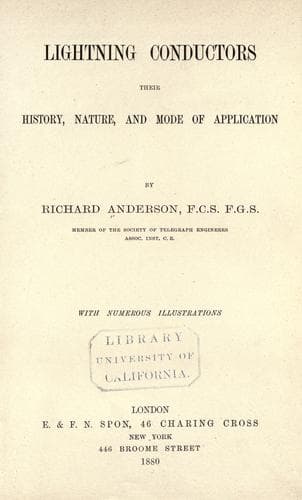
Lightning Conductors: Their History, Nature, and Mode of ApplicationAnderson, Richard, F.C.S.
History
Lightning Conductors: Their History, Nature, and Mode of Application
Anderson, Richard, F.C.S.
Lightning conductors
While thus the battle of the rods was being fought in England, it raged
no less hotly on the continent of Europe. Here there was religious
prejudice alone at work, the political sympathies running in favour
of anything coming from America. But priestly animosity by itself
proved as strong an obstacle as any other to the erection of lightning
conductors. Where it did not exist, they sprang up with rapidity; but
wherever its influence was felt, the movement was arrested. In the
most enlightened parts of Germany, the seat and home of Protestantism,
the ‘Franklin rods’ early made their appearance. The first lightning
conductor set up over a public building in Europe was erected early
in 1769 on the steeple of the church of St. Jacob, Hamburg; and so
rapid was the spread of them that, at the end of five years from
this date, there were estimated to be over seven hundred conductors
within a circle of ten miles of the old Hanse town. To this day
they are comparatively more numerous in this district than anywhere
else in Europe. In contrast with Northern Protestant Germany, the
Roman Catholic South refused the ‘Franklin rods,’ and so did France,
although making a hero of Franklin personally. For many years after
young Robespierre pleaded the case of lightning conductors before the
tribunal of St. Omer, the strongest abhorrence to them was expressed
by the priests and their mob following in almost all parts of France,
and the active antagonism did not cease till after the outbreak of the
great revolution.
Public-domain text, read in full here on John Shaqi.
Reviews
Reviews
No reviews yet
Be the first to share your thoughts on this work.
Join the Discussion
Join the discussion
Sign in to leave a comment or review.
Sign InorCreate an account