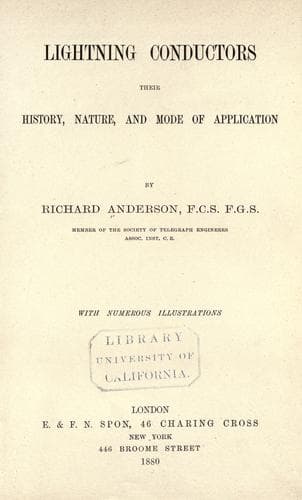
Lightning Conductors: Their History, Nature, and Mode of ApplicationAnderson, Richard, F.C.S.
History
Lightning Conductors: Their History, Nature, and Mode of Application
Anderson, Richard, F.C.S.
Lightning conductors
If it is easy to account for the old historical marvel of Solomon’s
temple having stood unharmed amidst the ragings of lightning from
tens of thousands of storms, it is more difficult to find the reason
why many buildings of another kind should be constantly under attack.
A notable case in point, related by the German naturalist G. Ch.
Lichtenberg, occurred at the village of Rosenberg, in the province
of Carinthia, Austria, belonging to the noble family of Orsini. The
village church, although not standing in a very elevated position, was
unceasingly struck, in the course of the seventeenth and eighteenth
centuries, by lightning, which sometimes battered in the roof,
sometimes broke down part of the steeple, and often flew in at the
window on one side and out on the other. Very possibly, there were
large pieces of metal on the wall, or in the roof; or, if not, there
may have been masses of water near, underground, sufficient to account
for the manifestations of the electric force. However, popular opinion,
utterly ignorant as to such causes, ascribed the whole to the doings
of evil spirits, and endless attempts were made to exorcise them
by prayers, fastings, and sprinkling of holy water. But it was all
unavailing. The lightning came again and again, and in the summer of
1730, a flash from the clouds, more violent than any preceding one,
demolished the entire steeple. The Orsini family, suspected by many of
the lower people of being the secret originators of all the mischief,
in league with the evil spirits, erected another steeple, handsomer and
far more solid than the one destroyed, to show their pious intentions.
But the lightning visited it as before, on the average five or six
times a year, doing so much damage that the whole church had to be
taken down in 1778, being found in ruins. Happily, in the meanwhile
the report had gone as far as the little village in Carinthia that
something had been discovered for guarding all buildings, including
spirit-haunted churches, against damage by lightning. Once more, the
proprietors of the village built a new church on the old ground, but
this time, by the advice of an Italian architect, they placed upon it
one of the ‘heretical rods,’ made famous for having done good service
in protecting the cathedral of Siena. Needless to say that it did again
similar service.
Public-domain text, read in full here on John Shaqi.
Reviews
Reviews
No reviews yet
Be the first to share your thoughts on this work.
Elsewhere in the archive
Join the Discussion
Join the discussion
Sign in to leave a comment or review.
Sign InorCreate an account