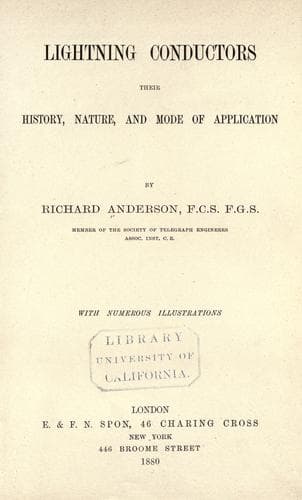
Lightning Conductors: Their History, Nature, and Mode of ApplicationAnderson, Richard, F.C.S.
History
Lightning Conductors: Their History, Nature, and Mode of Application
Anderson, Richard, F.C.S.
Lightning conductors
It is very probable that, besides the two causes just referred to which
divert the path of lightning, there are many others of influence,
at present entirely unknown. Numerous cases are reported where the
electric discharge from the clouds touched precisely, and with
singular accuracy, as if directed by a superior intelligence, the
same spot, without the slightest reason being discoverable for such
an action, after the most minute investigation by competent persons.
Thus, on June 29, 1763, a violent thunderstorm broke over the village
of Antrasme, near Laval, in France, the residence of a distinguished
investigator of electrical phenomena, Count de Labour-Landry, a friend
and correspondent of the Abbé Nollet as well as of Benjamin Franklin.
The lightning struck, as carefully ascertained by the Count, first
the steeple of the church, then sprang to one of the lower walls,
where it fused and blackened the gilding of picture frames and some
other metallic ornaments, melting also some pewter flasks used for
sacramental purposes, and finally opened two deep holes, as regular
as if they had been drilled with an auger, in a wooden table, placed
within a recess of soft stone. All these damages were duly repaired;
but, to the boundless surprise of the witnesses, the lightning struck
the church almost exactly a year after, on June 20, 1764, entering
the church by the same way as before, fusing and blackening the same
gildings, melting the same flasks, and, in the end, driving out the
very plugs of the wooden table inserted to fill the holes bored by
the previous stroke of lightning. The account of the whole might seem
almost incredible, were it not attested by independent eye-witnesses.
Arago, with absolute faith in their testimony, remarks thereon that
‘those who will take the trouble of reflecting upon the thousands of
combinations which might have caused the path of the lightning to have
been different in the two cases, will, I imagine, have no hesitation
in viewing, with me, the perfect identity of effect as demonstrating
the truth of a proposition I put forward,’ namely, that ‘lightning, in
its rapid march, is influenced by causes, or actions, dependent on the
terrestrial bodies near which it explodes.’ In other words, lightning,
like many other phenomena of earth, air, and water, is influenced by
unknown causes. Hamlet says very much the same, when exclaiming:
There are more things in heaven and earth, Horatio,
Than are dreamt of in your philosophy.
After all possible explanations, Arago could get no further than
Horatio, who thought that there was much in the universe which was
‘wondrous strange.’
Public-domain text, read in full here on John Shaqi.
Reviews
Reviews
No reviews yet
Be the first to share your thoughts on this work.
Elsewhere in the archive
Join the Discussion
Join the discussion
Sign in to leave a comment or review.
Sign InorCreate an account