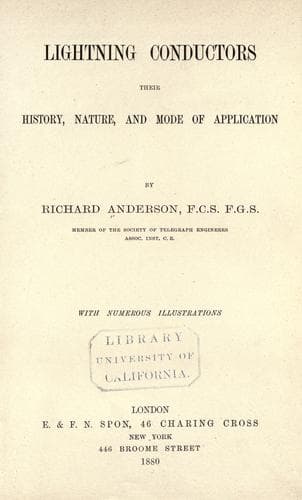
Lightning Conductors: Their History, Nature, and Mode of ApplicationAnderson, Richard, F.C.S.
History
Lightning Conductors: Their History, Nature, and Mode of Application
Anderson, Richard, F.C.S.
Lightning conductors
It does not seem impossible that some of the extraordinary effects
of lightning, either in striking repeatedly certain objects, or in
seldom or never touching others, may be explained on meteorological
grounds. The height, as well as thickness, of the clouds charged with
the electric fire, must naturally greatly influence the direction of
the latter, and though both elements vary enormously, in different
countries and at different seasons, it is likely enough that the
variation is comparatively trifling under given conditions, as, for
example, in a district where there are prevailing winds, and where the
configuration of the earth powerfully acts upon the drift and movement
of the aerial masses, and the atmospheric conditions in general. As
to the height of the clouds charged with lightning, there appears
scarcely any limit, as it has been found that they at times rise above
the summit of the most elevated mountain ridges on the face of the
globe. The great naturalist and traveller, Alexander von Humboldt,
measured the height of a storm cloud, discharging lightning, near the
mountain of Toluca, in Mexico, and found that it was no less than
4,620 metres, or 15,153 English feet, above the level of the sea. The
height of another, ascertained by Professor de Saussure, of Geneva,
when ascending Mont Blanc, was 4,810 metres, or 15,776 English feet,
or almost exactly three miles. Probably, these are exceptional cases,
as even in mountainous districts the heavy moist and electricity-laden
clouds seldom rise to such extraordinary heights; still, even such
as they are they do not represent the extreme limit of elevation. A
member of the French Academy of Sciences, M. De Lisle, records having
measured, by trigonometrical observations, the vertical height of
clouds in a thunderstorm, with strong flashes of lightning, which broke
over Paris, and found it to be 8,080 metres, or 26,502 English feet.
Consequently, this cloud-mass, charged with electricity, stood far
above the summit of the highest mountain peak in the world.
Public-domain text, read in full here on John Shaqi.
Reviews
Reviews
No reviews yet
Be the first to share your thoughts on this work.
Elsewhere in the archive
Join the Discussion
Join the discussion
Sign in to leave a comment or review.
Sign InorCreate an account