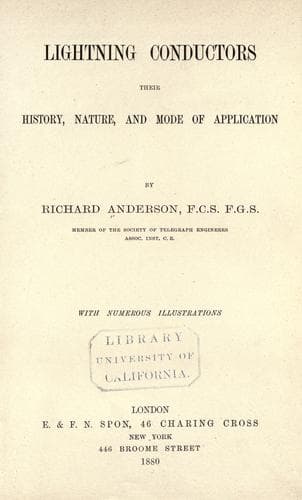
Lightning Conductors: Their History, Nature, and Mode of ApplicationAnderson, Richard, F.C.S.
History
Lightning Conductors: Their History, Nature, and Mode of Application
Anderson, Richard, F.C.S.
Lightning conductors
Most of the experiments and investigations for ascertaining the best
form of lightning conductors, and their application to buildings
so as to be invariably efficient, have been carried on by private
activity; still, the subject has also, at various times, undergone
the examination of official authorities, as well as of learned
societies. Little has been done in this respect in England, but very
much in France, where, ever since the publication of Franklin’s great
discovery, the question of protection against lightning has uniformly
interested the public, as well as the learned world, leading to
the production of more treatises on the subject than in any other
country, except perhaps Germany, the world’s centre of book-making.
One of the most important of the French works here referred to, and
which may be regarded as the standard work on lightning conductors,
is a semi-official publication, entitled ‘Instruction sur les
paratonnerres,’ issued in new editions from time to time, and widely
dispersed, not only in France, but all over Europe and America. It
consists of several reports about lightning conductors made, from
1823 to 1867, by committees comprising some of the most distinguished
men of science at the time, to the ‘Académie des Sciences’ of Paris.
The earliest of these reports originated from an application of
the French Government to the ‘Académie.’ In the year 1822, there
happened to be in France, and over the greater part of Continental
Europe, an extraordinary number of violent thunderstorms, accompanied
by earthquakes and simultaneous eruptions of Mount Vesuvius, the
latter on a scale not witnessed for centuries. In France, the almost
continuous thunderstorms caused great alarm among the population;
and the priests in many places held processions in and around the
churches, with special prayer-meetings, to ‘appease the wrath of
heaven.’ In consequence of all this excitement, the Minister of
the Interior, deeming that something also ought to be done besides
the walking in procession to stay the fatal effect of lightning,
ordered that all the public buildings in France should be protected
immediately by conductors, made on the most perfect model and placed
in the best manner. To get pre-eminent advice as to the efficiency of
lightning conductors, the Minister applied officially to the ‘Académie
des Sciences,’ which learned body thereupon nominated a committee
consisting of six of the most celebrated investigators of the phenomena
of electricity--MM. Poisson, Lefèvre-Gineau, Girard, Dulong, Fresnel,
and Gay-Lussac. The committee held many sittings, collecting a vast
amount of evidence on the subject, and on April 23, 1823, presented
through M. Gay-Lussac its report to the ‘Académie des Sciences,’
which was adopted and ordered to be printed, being declared a highly
important document. The French Government took the same view as the
‘Académie des Sciences,’ and not only acted upon the recommendations
Public-domain text, read in full here on John Shaqi.
Reviews
Reviews
No reviews yet
Be the first to share your thoughts on this work.
Elsewhere in the archive
Join the Discussion
Join the discussion
Sign in to leave a comment or review.
Sign InorCreate an account