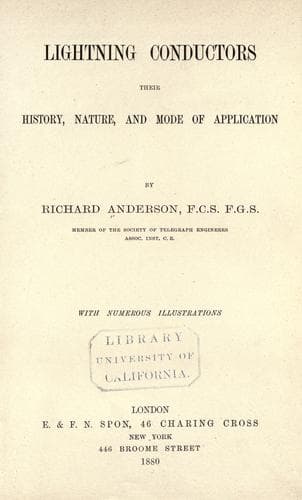
Lightning Conductors: Their History, Nature, and Mode of ApplicationAnderson, Richard, F.C.S.
History
Lightning Conductors: Their History, Nature, and Mode of Application
Anderson, Richard, F.C.S.
Lightning conductors
of the report, but issued it to all public functionaries, to the
clergy, and others, with directions to make it generally known. In
this way hundreds of thousands of copies of the ‘Instruction sur
les paratonnerres’ found their way all over France, and from thence
in translations all over Europe, as the best existing guide for the
erection of lightning conductors.
The information thus spread by the French Government gave rise to
important results. It caused the setting-up of lightning conductors
throughout the country, on private as well as public buildings, and
it likewise led to an improved construction of them, in as far as the
‘Instruction’ recommended the rods to be made of stout pieces of metal,
well fastened to each other, and, above all, led into the ground deep
enough to reach moist earth or water. If this was well enough, and
useful enough, to meet with general acceptation, there were some points
in the advice of the learned men of the ‘Académie’ that gave rise
to much criticism, as being more founded upon theory than practical
experience. In the first place, they laid it down as a hard-and-fast
rule that the upper rod of a lightning conductor--that projecting over
the roof--‘will be an efficient protective against lightning within
the circular area of a radius double that of its height,’[1] and the
acquiescence in this supposed absolute formula had for one of its
results the erection of monstrously huge rods, made to tower high above
buildings, so as to increase the field of protection to the largest
possible extent. Another and worse fault was committed by the authors
of the ‘Instruction’ in not saying anything about the necessity of
regularly inspecting the actual condition of lightning conductors, and
testing them in respect to their efficiency. While giving minute advice
as to the mode of construction and the general design of conductors,
the contents of the ‘Instruction’ were such that, on the whole, its
readers would take it for granted that it was only necessary to
properly join the strips of metals and bring them down into the ground,
after which, thenceforth and for ever, the protection against lightning
would be complete. This grave omission, together with the erroneous
dogma as to absolute rule of protection within an area prescribed by
the height of the ‘tige,’ or upper part of the rod, had the inevitable
result of causing disasters, and before the ‘Instruction’ had been
issued many years, there came report after report to the
[1] The original, long taken as a scientific dogma, runs: ‘Une
tige de paratonnerre protège efficacement contre la foudre
autour d’elle un espace circulaire d’un rayon double de sa
hauteur.’
Public-domain text, read in full here on John Shaqi.
Reviews
Reviews
No reviews yet
Be the first to share your thoughts on this work.
Elsewhere in the archive
Join the Discussion
Join the discussion
Sign in to leave a comment or review.
Sign InorCreate an account