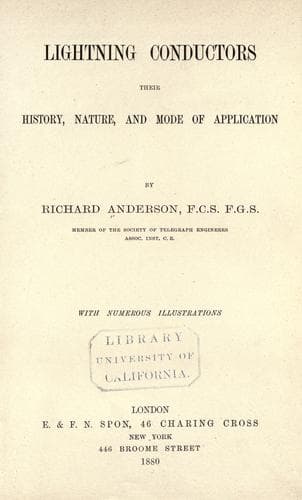
Lightning Conductors: Their History, Nature, and Mode of ApplicationAnderson, Richard, F.C.S.
History
Lightning Conductors: Their History, Nature, and Mode of Application
Anderson, Richard, F.C.S.
Lightning conductors
Government that well-constructed lightning conductors had failed to
do their duty. For a length of time these reports were either not
believed in, or the failure ascribed to partial non-compliance with
the strict rules laid down by the ‘Académie des Sciences.’ However, in
the end, when thirty years had passed, the instances of buildings with
conductors being struck became so numerous, that it was impossible to
ignore them any longer and, flying once more for advice to the savants
of the ‘Académie des Sciences,’ the French Government desired them
to investigate anew the question as to the best means of protecting
buildings against lightning. Complying with the behest, the learned
body nominated again a committee of six, the names of those selected
comprising the most eminent men who had made electricity and its
phenomena their study. They were MM. Becquerel, Babinet, Duhamel,
Despretz, Cagnard de Latour, and Pouillet.
The ‘Instruction’ of the new committee, drawn up by Professor Pouillet,
was read before the ‘Académie des Sciences’ on December 18, 1854, and
having been unanimously approved, was, like the former one, taken up by
the Government and extensively circulated. The report began by modestly
excusing the short-coming of its predecessor. ‘For the last thirty
years,’ Professor Pouillet remarked, with no fear of being gainsaid,
‘the science of electricity has made great progress--in 1823 the
discovery of electro-magnetism had only just been made, and none could
foresee the immense results that would spring from its revelations.’
Based upon these grounds, the new ‘Instruction’ entirely reversed
many of the conclusions of the old one. First of all, it declared
inadmissible the theory of a fixed area of protection, to be calculated
by the length of the upper rod. ‘Such a rule,’ Professor Pouillet
justly remarked, ‘cannot be laid down with any pretence to accuracy,
since the extent of the area of protection is dependent from a mass of
circumstances--such as, among others, the shape of the building and the
materials entering into its construction. It is clear, for example,
that the radius within which the conductor gives protection cannot be
so great for an edifice the roof or upper part of which contains large
quantities of metals, as for one which has nothing but bricks, wood, or
tiles.’ Professor Pouillet then proceeded to give detailed instructions
in respect to the design and mode of manufacturing lightning
conductors. He insisted that the rods should be of greater capacity
than those recommended by Gay-Lussac in the report of 1823, and that
there should be as few joints as possible from the point to the earth.
He considered it of the greatest importance that all the joints should
be carefully tin soldered, otherwise the metallic continuity of the
conductor could not be assured. He also advised that the top of the
air-terminal should not taper to so fine a point as formerly, but
be rather blunt.
Public-domain text, read in full here on John Shaqi.
Reviews
Reviews
No reviews yet
Be the first to share your thoughts on this work.
Elsewhere in the archive
Join the Discussion
Join the discussion
Sign in to leave a comment or review.
Sign InorCreate an account