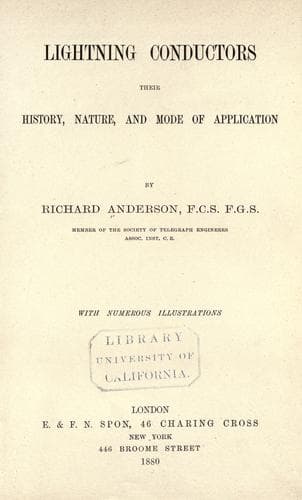
Lightning Conductors: Their History, Nature, and Mode of ApplicationAnderson, Richard, F.C.S.
History
Lightning Conductors: Their History, Nature, and Mode of Application
Anderson, Richard, F.C.S.
Lightning conductors
The report on the protection of the Louvre Palace did not contain
the last inquiry of the ‘Académie des Sciences’ on the subject of
lightning conductors. Twelve years after it had been issued, the
Government of France once again called upon that learned body for
advice as to the best mode of protecting powder magazines. Several
cases had happened--among others at Rocroy, on the borders of the
forest of Ardennes--of such buildings being struck, notwithstanding
that they had conductors placed upon them, and the Government,
naturally alarmed, made inquiry as to whether nothing could be done to
ensure protection against lightning, infallible under all atmospheric
conditions and every possible emergency, to these dangerous stores. The
demand was made in a letter of the Minister of War, Marshal Vaillant,
dated October 27, 1866, pressing the ‘Académie’ to give another
‘Instruction,’ without delay, the Government being ‘in fear that some
of the powder magazines are not as completely protected from lightning
as could be wished.’ Thereupon the ‘Académie des Sciences’ nominated
another commission, this time of eight members, including the Minister
of War himself--not complimentary, but as being an author, and with a
warm interest in electrical science; and, besides him, MM. Becquerel
Sen., Babinet, Duhamel, Fizeau, Edmond Becquerel, Regnault, and
Professor Pouillet. The list represented a galaxy of names unsurpassed
in the investigation of such a subject as lightning conductors, looked
upon in most countries of Europe, at least in recent years, as rather
plebeian, to be left to builders and lightning rod men. Many sittings
were held by the committee, all fully attended, so that, although
the Minister had desired to get the new report ‘_le plus promptement
possible_,’ it was not till nearly three months after the receipt of
his message that it was completed, Professor Pouillet again being the
author. It was a most remarkable paper, this one, read before and
approved of by the ‘Académie des Sciences’ on January 14, 1867.
Public-domain text, read in full here on John Shaqi.
Reviews
Reviews
No reviews yet
Be the first to share your thoughts on this work.
Elsewhere in the archive
Join the Discussion
Join the discussion
Sign in to leave a comment or review.
Sign InorCreate an account