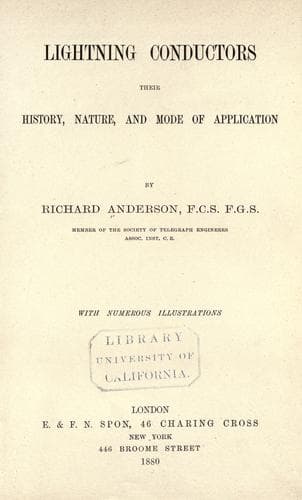
Lightning Conductors: Their History, Nature, and Mode of ApplicationAnderson, Richard, F.C.S.
History
Lightning Conductors: Their History, Nature, and Mode of Application
Anderson, Richard, F.C.S.
Lightning conductors
Before entering upon the subject of the protection of powder magazines
against lightning, the new ‘Instruction’ signed by Professor
Pouillet and his colleagues laid down a few so-called ‘_propositions
générales_‘--that is, either hints, suggestions, or statements,
the French word ‘_proposition_’ being most serviceably vague for
use--on the subject of lightning and of thunderstorms. The first
thesis affirmed that ‘clouds which carry lightning with them are but
ordinary clouds (_ne sont autre chose que des nuages ordinaires_)
charged with a large quantity of electricity.’ The second thesis
boldly defined the nature of lightning. ‘The fire which flashes
from the skies is an immense electric spark, passing either from
one cloud to another, or from a cloud to the earth; it is caused
by a tendency for the restoration of the electric equilibrium (_la
recomposition des électricités contraires_).’ It was laid down in the
third ‘_proposition_’ that, when lightning falls from a cloud upon the
earth, it is but an effort of the electric force to return to its
grand reservoir. That it is similar to water, which, having risen in
the form of vapour from the earth-surrounding ocean high up into the
air, then falls down as rain upon hills and plains, and finally runs
down again in rivers to the ocean, Professor Pouillet did not say in
so many words; but there were vague hints to that effect in the new
‘Instruction.’ Its practical recommendation, offspring of the theories
thus enunciated, was that the best protection against lightning
would be afforded by the most substantial metal rods, made of iron,
surrounding a building on all sides, and passing deep into the ground.
The new declaration of the ‘Académie des Sciences,’ though merely a
repetition of former reports, was not without important consequences.
First in France, and then in other countries, the conviction became
general among scientific men, and others well informed on the subject,
that well-designed conductors, if properly made and kept in good order,
form an absolute, unconditional, and infallible protection against
lightning.
Professor Pouillet also laid it down that lightning conductors, to be
efficient, must be regularly inspected, he, with his colleagues on the
committee, having come to the conclusion that such examination should
take place at least once every year. So much stress was laid upon the
importance of an annual inspection, that a strong recommendation was
made to the Government to have a _procès-verbal_, or special report,
drawn up on each occasion in the case of all public buildings, so that
it might be known by the central authorities whether the examination
had taken place at the specified time, and what had been the
declaration of the examiners. The advice was judiciously followed, with
the result that at this moment the public buildings of France have the
most complete protection against lightning--greatly in contrast with
the public buildings in England.
CHAPTER VIII.
Public-domain text, read in full here on John Shaqi.
Reviews
Reviews
No reviews yet
Be the first to share your thoughts on this work.
Elsewhere in the archive
Join the Discussion
Join the discussion
Sign in to leave a comment or review.
Sign InorCreate an account