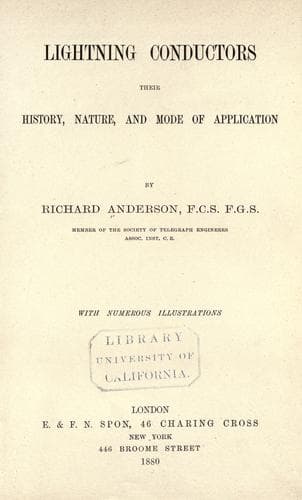
Lightning Conductors: Their History, Nature, and Mode of ApplicationAnderson, Richard, F.C.S.
History
Lightning Conductors: Their History, Nature, and Mode of Application
Anderson, Richard, F.C.S.
Lightning conductors
The battle, resulting as it did in ultimate victory, was a long one,
nevertheless. For many years, all his efforts to induce the British
Government to adopt a system of efficient lightning conductors for the
Royal Navy remained entirely fruitless; and it was only after he had
gained the sympathy of the press, and, through it, of the public, by
publishing long lists of the disasters that had befallen the cherished
‘wooden walls of England,’ that at last the closed doors of the
Admiralty were opened to him. The lists he furnished were appalling
indeed, and enough to impress any minds and open any doors. It was
shown by Mr. Snow Harris, from carefully compiled records, based upon
official documents, that in the course of forty years--from 1793 to
1832--over 250 ships had suffered from lightning. In 150 cases, the
majority of which occurred between the years 1799 and 1815, about 100
main-masts of line-of-battle ships and frigates, with a still larger
number of topmasts and smaller spars, together with an immense quantity
of stores, were destroyed by lightning. One ship in eight was set on
fire in some part of the rigging or sails, and over 200 seamen were
either killed or severely disabled. But, formidable as was this account
of damage done by lightning, it by no means completed the list of
casualties. Mr. Snow Harris gave it as his opinion, on the authority of
a great many naval officers with whom he came into contact at Plymouth,
that many ships reported officially as ‘missing’ had been struck by
lightning and gone to the bottom, with nobody left behind to tell the
tale. Thus, from a reference to the log of the line-of-battle ship
the ‘Lacedæmonian,’ under the command of Admiral Jackson, it appeared
that this man-of-war sailed alongside a frigate, the ‘Peacock,’ on the
coast of Georgia, in the summer of 1814, and that the latter suddenly
disappeared in a storm of lightning, leaving no trace behind. Again,
the ‘Loup Cervier,’ another man-of-war, was last seen off Charlestown,
in America, on the evening of a severe thunderstorm, and never heard
of again. A famous ship, the ‘Resistance,’ of forty-four guns, was
struck by lightning in the Straits of Malacca, and the powder-magazine
blowing up, it went to the bottom, only three of the crew reaching the
shore, picked up by a passing Malay boat. But for these few survivors,
Mr. Snow Harris justly remarked, nothing would have been known of
the fate of the vessel, which would have been simply reported as
‘missing’ in the Admiralty lists. It was scarcely to be wondered at
that the recital of all these tales of disasters, which might have been
prevented by the most ordinary foresight in applying known means of
protection against lightning, considerably excited the public mind, so
that at last the Government was compelled to act in the direction into
which it was impelled by the energetic Plymouth doctor. It was thus
that at last, in 1839, the naval commission already referred to was
Public-domain text, read in full here on John Shaqi.
Reviews
Reviews
No reviews yet
Be the first to share your thoughts on this work.
Elsewhere in the archive
Join the Discussion
Join the discussion
Sign in to leave a comment or review.
Sign InorCreate an account