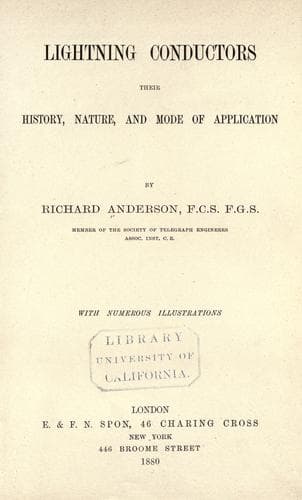
Lightning Conductors: Their History, Nature, and Mode of ApplicationAnderson, Richard, F.C.S.
History
Lightning Conductors: Their History, Nature, and Mode of Application
Anderson, Richard, F.C.S.
Lightning conductors
In the story of the progress of lightning protection in England, the
career of William Snow Harris forms a chapter of no little interest,
as showing both the inertness of the administration, as well as of
the public, in the most important matters, and the good effects that
may result from the persevering energy of a single man. When Mr.
Snow Harris began his agitation for lightning conductors, about the
year 1820, the ships of the Royal Navy were virtually without them,
although they had something supposed to stand in their place. Just
sixty years before, in 1762, Dr. William Watson, the indefatigable
advocate of Franklin’s discovery, had strongly recommended to Lord
Anson, first Lord of the Admiralty, that all men-of-war should have
lightning conductors; and his urgent zeal, backed by influential
friends, effected that his advice was listened to. Being requested to
send in the best design for a ship’s conductor, Dr. Watson did so with
alacrity, but, unfortunately, with little wisdom. Knowing little or
nothing of ships and their management at sea, the learned member of
the Royal Society advised that the lightning conductors for the navy
should be constructed of strips of copper rod, one-fourth of an inch
in diameter, hooked together every few feet by links, and the whole
attached, for more security, to a hempen line, to be hung on to a
metal spike on the top of the mast, and from thence to fall down into
the sea. In theory, it was not a bad design, but it utterly failed in
practice. Evidently, Dr. Watson had never been on board of a large ship
in a gale, for had he been, he might have known that it would be next
to impossible to keep his chain in its place, exposed as it was to the
operation of violent mechanical forces, not to speak of possible bad
treatment from indignant sailors, with whose movement in the rigging
it interfered. It was a natural consequence of Dr. Watson’s ignorance,
that his conductors entirely failed. In most cases the commanders of
men-of-war, supplied with the copper-hempen chains, quietly stowed them
away in some corner of the ship, with orders to take them out when
needed, and it often happened that this was done only after the ship
had been struck by lightning. Year after year there came reports of
such casualties; and at last they got so numerous as really to attract
the attention of the naval authorities. Still, nothing was done until
William Snow Harris took up the matter. Sitting in his little cottage
at Plymouth, overlooking the sea, the happy thought struck the young
medical man, waiting for patients who did not come, that here might
be found a profitable as well as useful opening for his activity.
He possessed, happily, a few naval friends, ready with counsel and
assistance, and so he went to action, fighting for lightning conductors.
Public-domain text, read in full here on John Shaqi.
Reviews
Reviews
No reviews yet
Be the first to share your thoughts on this work.
Elsewhere in the archive
Join the Discussion
Join the discussion
Sign in to leave a comment or review.
Sign InorCreate an account